Western Political Thought: Complete Guide to Political Thinkers, Theories, and Exam Notes (UGC NET, CUET PG, UPSC)
Learn Western Political Thought with detailed notes on Plato, Aristotle, Machiavelli, Hobbes, Locke, Rousseau, Marx, Rawls, Gramsci, Wollstonecraft, Fanon, Arendt, Mill, Hegel, Mao, and Confucius. Ideal for UGC NET Political Science, CUET PG, UPSC PSIR, and MA Political Science.
 politicalsciencesolution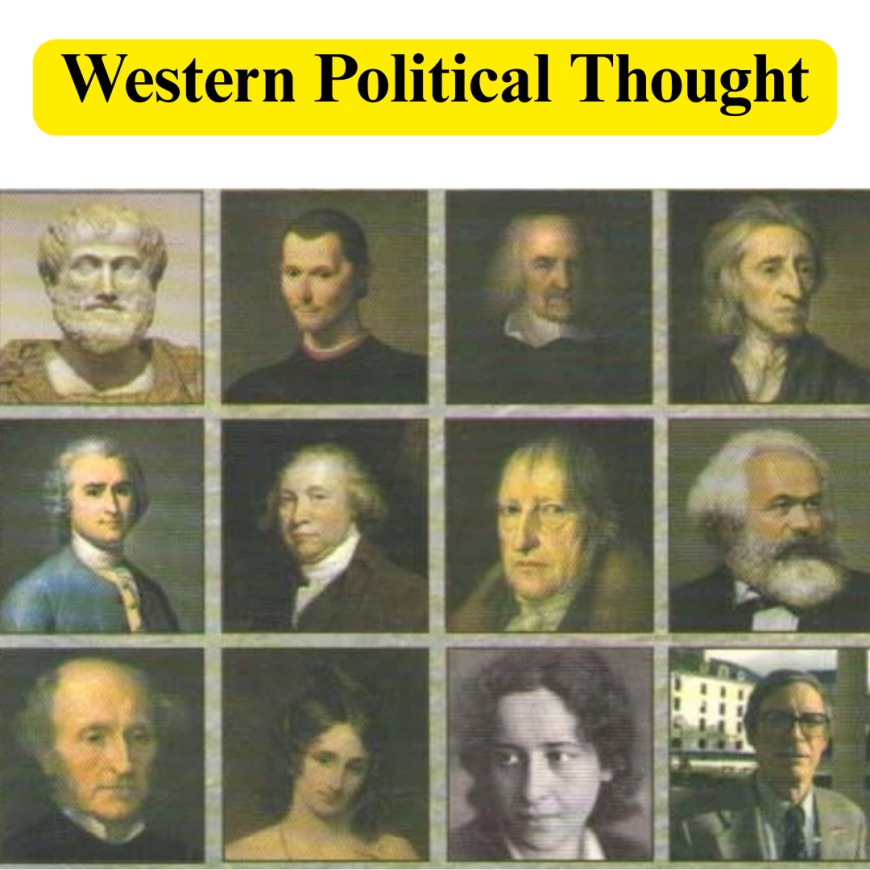
Western Political Thought is one of the most important branches of Political Science. It studies the evolution of political ideas, the state, justice, liberty, equality, democracy, sovereignty, rights, citizenship, and governance through the writings of major political philosophers.
From Plato's ideal state to John Rawls' theory of justice, Western Political Thought has shaped modern political institutions, constitutional democracy, liberalism, socialism, nationalism, feminism, and human rights.
For students preparing for UGC NET Political Science, CUET PG, UPSC PSIR, MA Political Science, BA Political Science, and State PSC examinations, mastering Western Political Thought is essential because questions from this unit appear every year.
Political Science Solution provides comprehensive Political Science Notes covering every major thinker and political theory for competitive examinations.
Political Science Notes
Looking for complete Political Science study material?
Visit our Political Science Notes section where you'll find:
- UGC NET Political Science Notes
- CUET PG Political Science Notes
- BA & MA Political Science Study Material
- UPSC PSIR Notes
- Previous Year Questions
- Unit-wise Revision Notes
- Current Affairs
- Practice MCQs
Related Resource:
Western Political Thought
What is Western Political Thought?
Western Political Thought refers to the political ideas developed mainly in Europe from Ancient Greece to the contemporary period.
It examines:
- Nature of the State
- Justice
- Liberty
- Equality
- Rights
- Sovereignty
- Citizenship
- Democracy
- Revolution
- Political Obligation
- Human Rights
- Feminism
- Marxism
- Liberalism
Western political philosophy evolved through several historical phases.
Evolution of Western Political Thought
1. Ancient Greek Political Thought
- Plato
- Aristotle
Focus:
- Justice
- Virtue
- Citizenship
- Ideal State
2. Medieval Political Thought
Influenced by Christianity and Church authority.
3. Renaissance Political Thought
- Machiavelli
Focus:
- Realism
- Statecraft
- Power Politics
4. Social Contract Thinkers
- Thomas Hobbes
- John Locke
- Jean Jacques Rousseau
Focus:
- State of Nature
- Social Contract
- Sovereignty
- Consent
5. Liberal Political Thought
- J.S. Mill
- John Locke
- John Rawls
Focus:
- Liberty
- Rights
- Democracy
6. Idealist Political Thought
- Hegel
Focus:
- Ethical State
- Freedom
7. Socialist and Marxist Thought
- Karl Marx
- Antonio Gramsci
Focus:
- Class
- Capitalism
- Revolution
- Hegemony
8. Feminist Political Thought
- Mary Wollstonecraft
Focus:
- Women's Rights
- Equality
- Education
9. Contemporary Political Thought
- John Rawls
- Hannah Arendt
- Frantz Fanon
Major Thinkers in Western Political Thought
1. Plato (427–347 BCE)
Major Works
- The Republic
- Laws
- Statesman
Key Ideas
- Theory of Justice
- Philosopher King
- Theory of Forms
- Ideal State
- Tripartite Soul
- Education
- Communism of Guardians
Contribution
Plato believed justice exists when every class performs its own function.
He divided society into:
- Rulers
- Soldiers
- Producers
2. Aristotle (384–322 BCE)
Major Works
- Politics
- Nicomachean Ethics
Key Ideas
- Man is a Political Animal
- Constitutional Government
- Rule of Law
- Citizenship
- Middle Class Theory
- Classification of Governments
Famous Quote
"Man is by nature a political animal."
3. Niccolò Machiavelli (1469–1527)
Major Work
The Prince
Key Ideas
- Political Realism
- Separation of Politics and Morality
- Reason of State
- Power Politics
- Virtù and Fortuna
Known as the Father of Modern Political Science.
4. Thomas Hobbes (1588–1679)
Major Work
Leviathan
Key Ideas
- State of Nature
- Absolute Sovereignty
- Social Contract
- Security
Famous Quote
Life in the state of nature is:
"Solitary, poor, nasty, brutish and short."
5. John Locke (1632–1704)
Major Works
- Two Treatises of Government
- Letter Concerning Toleration
Key Ideas
- Natural Rights
- Limited Government
- Consent
- Right to Revolution
- Constitutionalism
Natural Rights:
- Life
- Liberty
- Property
Known as the Father of Liberalism.
6. G.W.F. Hegel (1770–1831)
Major Works
- Philosophy of Right
- Phenomenology of Spirit
Key Ideas
- Ethical State
- Dialectics
- Freedom
- Civil Society
- Historical Development
7. Jean Jacques Rousseau (1712–1778)
Major Works
- Social Contract
- Emile
- Discourse on Inequality
Key Ideas
- General Will
- Popular Sovereignty
- Freedom
- Equality
- Civic Education
Famous Quote
"Man is born free, and everywhere he is in chains."
8. John Stuart Mill (1806–1873)
Major Works
- On Liberty
- Considerations on Representative Government
- The Subjection of Women
Key Ideas
- Liberty
- Harm Principle
- Representative Democracy
- Women's Rights
- Individualism
9. Karl Marx (1818–1883)
Major Works
- Communist Manifesto
- Das Kapital
Key Ideas
- Historical Materialism
- Class Struggle
- Alienation
- Capitalism
- Revolution
- Communism
10. Antonio Gramsci (1891–1937)
Major Work
Prison Notebooks
Key Ideas
- Cultural Hegemony
- Civil Society
- Organic Intellectuals
- Counter-Hegemony
11. Mary Wollstonecraft (1759–1797)
Major Work
A Vindication of the Rights of Woman
Key Ideas
- Feminism
- Women's Education
- Equality
- Rationality
- Rights
Known as the Mother of Liberal Feminism.
12. John Rawls (1921–2002)
Major Work
A Theory of Justice
Key Ideas
- Justice as Fairness
- Original Position
- Veil of Ignorance
- Difference Principle
- Equal Liberty
13. Frantz Fanon (1925–1961)
Major Works
- Black Skin, White Masks
- The Wretched of the Earth
Key Ideas
- Colonialism
- Decolonization
- Violence
- Liberation
- Identity
14. Hannah Arendt (1906–1975)
Major Works
- The Human Condition
- Eichmann in Jerusalem
- Origins of Totalitarianism
Key Ideas
- Totalitarianism
- Public Sphere
- Political Action
- Power
- Authority
15. Mao Zedong (1893–1976)
Major Works
- On Contradiction
- On Practice
- Little Red Book
Key Ideas
- Marxism-Leninism
- Peasant Revolution
- New Democracy
- Mass Line
- Cultural Revolution
16. Confucius (551–479 BCE)
Although Confucius is traditionally associated with Eastern Political Thought, his ideas are often included in comparative political thought courses due to their global influence.
Major Work
The Analects
Key Ideas
- Moral Government
- Virtue
- Benevolent Rule
- Family Ethics
- Harmony
- Meritocracy
Comparative Table of Major Thinkers
| Thinker | Core Concept | Major Work |
|---|---|---|
| Plato | Justice, Philosopher King | The Republic |
| Aristotle | Political Animal | Politics |
| Machiavelli | Political Realism | The Prince |
| Hobbes | Absolute Sovereignty | Leviathan |
| Locke | Natural Rights | Two Treatises |
| Rousseau | General Will | Social Contract |
| Hegel | Ethical State | Philosophy of Right |
| J.S. Mill | Liberty | On Liberty |
| Marx | Class Struggle | Das Kapital |
| Gramsci | Cultural Hegemony | Prison Notebooks |
| Wollstonecraft | Feminism | Rights of Woman |
| Rawls | Justice as Fairness | A Theory of Justice |
| Fanon | Decolonization | Wretched of the Earth |
| Hannah Arendt | Totalitarianism | The Human Condition |
| Mao | Peasant Revolution | On Practice |
| Confucius | Moral Government | Analects |
Importance of Western Political Thought
Western Political Thought helps students understand:
- Evolution of democracy
- Constitutional government
- Human rights
- Justice
- Liberty
- Equality
- Political institutions
- Citizenship
- Feminism
- Marxism
- Liberalism
- Nationalism
- Modern political ideologies
It forms the theoretical foundation for contemporary political systems and comparative political analysis.
Western Political Thought in UGC NET Political Science
Western Political Thought is a high-weightage area in UGC NET Political Science (Unit 1). Questions are frequently asked on:
- Plato's Justice
- Aristotle's Classification of Governments
- Machiavelli's Political Realism
- Hobbes' Sovereignty
- Locke's Natural Rights
- Rousseau's General Will
- Hegel's Dialectics
- Mill's Harm Principle
- Marx's Historical Materialism
- Gramsci's Cultural Hegemony
- Rawls' Veil of Ignorance
- Wollstonecraft's Feminism
- Fanon's Decolonization
- Arendt's Totalitarianism
Students should prepare these thinkers with their major works, concepts, criticisms, and previous-year questions.
Frequently Asked Questions (FAQs)
What is Western Political Thought?
Western Political Thought is the study of political ideas, institutions, and philosophies developed primarily in Europe, from Ancient Greece to the modern era. It explores concepts such as justice, liberty, equality, sovereignty, democracy, rights, and the state.
Who is the father of Western Political Thought?
Plato is widely regarded as the father of Western Political Thought due to his systematic analysis of justice, the ideal state, and political philosophy in The Republic.
Why is Aristotle called the father of Political Science?
Aristotle is called the father of Political Science because he adopted an empirical and comparative approach to studying constitutions and governments, making politics a distinct field of inquiry.
Is Confucius a Western political thinker?
No. Confucius is a classical Chinese philosopher and belongs to Eastern Political Thought. However, his ideas are often studied alongside Western thinkers in comparative political thought courses because of their enduring influence on political ethics and governance.
Which thinkers are most important for UGC NET Political Science?
The most frequently tested thinkers include Plato, Aristotle, Machiavelli, Hobbes, Locke, Rousseau, Hegel, J.S. Mill, Karl Marx, Antonio Gramsci, Mary Wollstonecraft, John Rawls, Frantz Fanon, and Hannah Arendt.
Conclusion
Western Political Thought traces the development of political philosophy from the classical ideals of Plato and Aristotle to contemporary debates on justice, democracy, equality, feminism, and post-colonialism advanced by Rawls, Fanon, and Arendt. Studying these thinkers enables students to understand the foundations of modern political institutions, constitutional governance, human rights, and competing political ideologies.
For comprehensive topic-wise notes, exam-oriented explanations, previous-year questions, and revision material, explore the Political Science Notes section on Political Science Solution:
Western Political Thought