Top-Rated AI and Data Analytics Courses in India (2026)
 vishalyk35
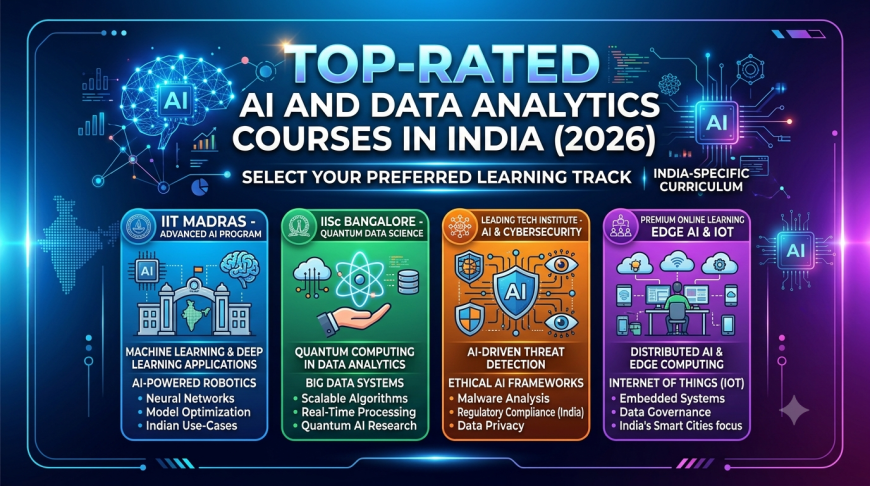
India's AI and data analytics education market has expanded rapidly, with universities, ed-tech platforms, and specialised institutes all competing to offer relevant, career-focused programmes. For prospective learners, this growth is both an opportunity and a challenge — more choice, but also more noise to filter through. This blog outlines what distinguishes genuinely top-rated AI and data analytics courses in India in 2026, and what to look for as you compare your options.
What "Top-Rated" Should Actually Mean
Course ratings and rankings can be misleading if they're based purely on marketing reach or number of enrolments rather than actual learning outcomes. A genuinely top-rated AI and data analytics course should be evaluated against a few concrete criteria: curriculum depth and currency, faculty and institutional credibility, hands-on project components, and verifiable career outcomes among past learners.
Categories of AI and Data Analytics Courses in India
-
University-affiliated postgraduate certificate programmes: Offered in partnership with recognised universities or premier institutes, typically spanning several months to a year, with strong academic rigour and structured curricula.
-
Ed-tech platform courses: Delivered through dedicated online learning platforms, ranging from short skill-specific courses to comprehensive, multi-month programmes with mentorship and project components.
-
Corporate and vendor-specific certifications: Focused on specific tools or platforms (cloud AI services, specific analytics software), useful for professionals needing tool-specific proficiency.
-
Bootcamp-style intensive programmes: Compressed, intensive courses (often a few weeks to a few months) designed to build job-ready skills quickly, often with a strong project and portfolio focus.
What to Look for in a Top-Rated Programme
-
Curriculum covering both AI and analytics fundamentals: Strong programmes typically include statistics, data visualisation, machine learning fundamentals, and practical AI application — not just one narrow slice of the field.
-
Hands-on projects with real or realistic datasets: The strongest indicator of a quality programme is whether learners build a portfolio of practical work, not just complete quizzes and watch videos.
-
Current tools and platforms: Look for coverage of widely used analytics and AI tools relevant to your target industry, updated regularly to reflect current industry practice.
-
Experienced faculty or industry mentors: Programmes with instructors who have real industry experience in AI and analytics generally provide more practical, relevant guidance than purely academic instructors.
-
Structured career support: Some programmes include resume building, interview preparation, or placement assistance — valuable if a job or role change is your primary goal.
Specialisation Areas Within AI and Data Analytics Courses
-
Business analytics: Focused on using data to inform business decisions, ideal for professionals in strategy, operations, or general management roles.
-
Data science and machine learning: More technical, covering statistical modelling, machine learning algorithms, and programming — suited to those aiming for hands-on technical roles.
-
AI applications for specific industries: Some programmes offer industry-specific tracks (finance, healthcare, retail), combining AI/analytics fundamentals with domain-specific use cases.
-
AI-driven decision sciences: Focused on using AI and analytics for strategic decision-making at an organisational level, often suited to mid-to-senior professionals.
How to Evaluate Course Quality Beyond Marketing Claims
-
Request a detailed syllabus: Course names can sound comprehensive while covering surface-level content — always review the actual module breakdown before enrolling.
-
Check for independent reviews: Look for reviews on independent platforms or forums, rather than relying solely on testimonials curated by the course provider.
-
Verify institutional or industry backing: Confirm any claimed university affiliation or industry partnership directly, rather than taking marketing claims at face value.
-
Ask about batch size and interaction: Smaller batches with more faculty interaction often deliver better learning outcomes than large, impersonal cohorts.
Choosing Based on Your Career Stage
-
Early-career professionals: May benefit most from comprehensive, longer-duration programmes that build strong foundational skills across both AI and analytics.
-
Mid-career professionals: Often benefit from more targeted, applied courses that build specific skills relevant to an immediate role change or promotion.
-
Senior professionals: May prioritise strategic, decision-science-focused programmes over deeply technical ones, depending on whether they're building AI literacy for leadership or transitioning into a hands-on technical role.
The Role of Alumni Outcomes in Course Selection
Beyond curriculum and faculty, it's worth researching what past learners from a specific programme have gone on to do professionally. Many quality providers publish anonymised outcome data or case studies of graduates who moved into new roles or received promotions after completing the course. While individual outcomes always depend heavily on the learner's own effort and prior background, a pattern of credible, verifiable success stories is a reasonably strong signal that a programme delivers real value rather than just a certificate.
Making Your Final Decision
Rather than chasing the single "best" course based on rankings alone, shortlist two or three programmes that align with your specific goals, compare their detailed curricula, verify institutional credibility, and — where possible — speak with current or past learners about their actual experience. This approach consistently leads to better outcomes than choosing based on advertising reach or price alone.
You can explore ai and data analytics courses designed with structured, industry-relevant curricula to help you build practical, in-demand skills for your specific career goals.
Frequently Asked Questions
How do I know if an AI and data analytics course is genuinely top-rated?
Look beyond marketing claims to curriculum depth, hands-on project components, faculty credibility, and independent reviews from past learners.
Should I choose a university-affiliated course or an ed-tech platform course?
This depends on your priorities — university-affiliated programmes often carry stronger academic credibility, while ed-tech platforms may offer more flexibility and faster completion.
Is a bootcamp-style course sufficient for a career in AI and analytics?
Bootcamps can build job-ready skills quickly, but their effectiveness depends heavily on the quality of the curriculum and how actively you apply the skills afterward.
How important are hands-on projects in these courses?
Very important — practical, portfolio-building projects are one of the strongest indicators of a course's real-world value and are often what employers look for during hiring.