Top Raman Testing Labs: Services, Benefits & What to Expect
Raman Testing Labs provide accurate material analysis. Discover services, benefits, and what to expect before choosing the right lab for your needs.
 labatoz
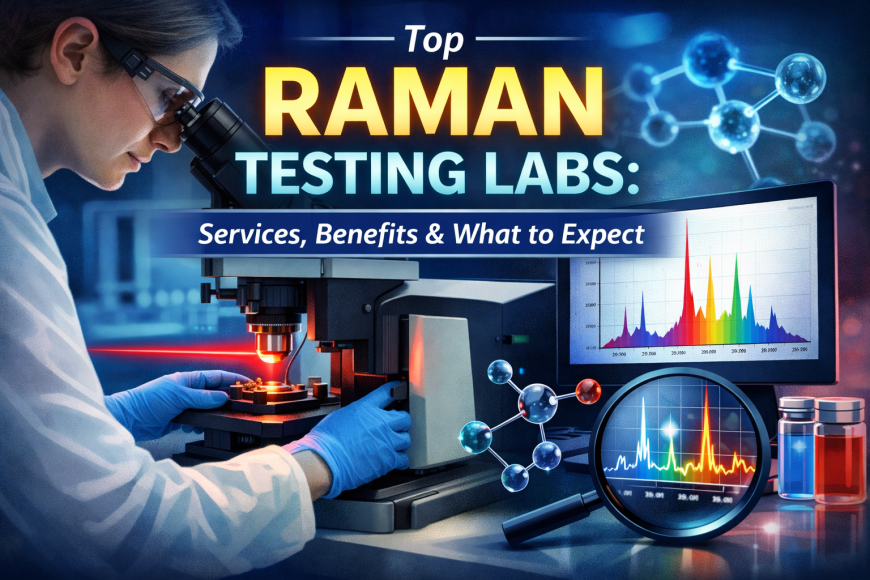
Raman spectroscopy has become one of the most powerful and versatile analytical tools in modern science and industry. From pharmaceutical quality control to nanomaterials research, Raman testing labs provide critical insights into molecular composition, structure, and chemical behavior — all without destroying the sample.
This detailed guide explores what top Raman testing labs offer, the benefits of Raman analysis, and what clients should expect when partnering with a professional laboratory.
Understanding Raman Spectroscopy
Raman spectroscopy is based on the Raman Effect, discovered by Indian physicist C. V. Raman, who was awarded the Nobel Prize in Physics for his groundbreaking work. The technique involves directing a monochromatic laser onto a sample and analyzing the scattered light to determine molecular vibrations.
Each molecule scatters light in a unique way, producing a characteristic spectral fingerprint. This makes Raman spectroscopy highly specific and reliable for identifying unknown substances and analyzing chemical structures.
Unlike many traditional analytical techniques, Raman spectroscopy is:
-
Non-destructive
-
Rapid
-
Highly specific
-
Capable of minimal sample preparation
-
Suitable for solids, liquids, and gases
Services Offered by Top Raman Testing Labs
Leading Raman laboratories offer a comprehensive range of services across industries.
1. Material Identification & Characterization
One of the most common applications is identifying unknown substances. Labs use extensive spectral libraries and advanced software to match sample spectra with known materials.
Applications include:
-
Polymer identification
-
Chemical compound verification
-
Pigment and dye analysis
-
Raw material authentication
-
Mineral and geological sample testing
Advanced characterization may include:
-
Crystallinity assessment
-
Phase identification
-
Stress/strain analysis
-
Structural disorder evaluation
2. Pharmaceutical Testing & Quality Control
The pharmaceutical industry heavily relies on Raman spectroscopy due to its precision and regulatory compatibility.
Key services include:
-
Active Pharmaceutical Ingredient (API) identification
-
Polymorph detection
-
Counterfeit drug screening
-
Blend uniformity analysis
-
In-line process monitoring (PAT applications)
Raman spectroscopy is particularly valuable because it can analyze tablets and capsules directly through packaging in some cases, reducing contamination risk.
3. Raman Mapping & Imaging
Advanced Raman labs offer chemical mapping and imaging services. This involves scanning across a surface to create a spatial distribution map of chemical components.
Used for:
-
Coating thickness analysis
-
Multilayer film evaluation
-
Composite material studies
-
Micro-contamination detection
-
Semiconductor defect analysis
This service is especially critical in electronics, nanotechnology, and materials science research.
4. Nanotechnology & Advanced Materials Analysis
Raman spectroscopy is highly sensitive to carbon-based materials, making it essential for:
-
Graphene characterization
-
Carbon nanotube analysis
-
Thin-film studies
-
Battery materials testing
-
Semiconductor materials
Raman spectra can reveal structural defects, layer thickness, and material quality — crucial for R&D and manufacturing control.
5. Failure Analysis & Contamination Detection
When products fail or contamination occurs, Raman testing can identify root causes quickly.
Labs can detect:
-
Surface residues
-
Unknown particles
-
Degradation products
-
Chemical incompatibilities
-
Oxidation or corrosion compounds
Because the technique is non-destructive, the same sample can undergo additional complementary testing if needed.
6. Forensic & Environmental Testing
Raman testing labs also support:
-
Forensic drug identification
-
Explosive residue detection
-
Microplastic analysis
-
Hazardous substance identification
-
Soil and water contaminant screening
Portable Raman systems are sometimes used in field investigations for rapid on-site screening.
Benefits of Choosing a Top Raman Testing Lab
Not all labs are created equal. Leading laboratories provide technological advantages and professional expertise that ensure accurate, reproducible results.
1. Advanced Instrumentation
Top labs use state-of-the-art Raman spectrometers featuring:
-
Multiple laser wavelengths
-
High-resolution detectors
-
Confocal microscopy integration
-
Temperature-controlled stages
-
Automated mapping systems
This allows testing of a wider range of materials with greater precision.
2. Expert Data Interpretation
Raman spectra can be complex. Skilled analysts ensure:
-
Accurate peak assignment
-
Proper baseline correction
-
Fluorescence management
-
Statistical validation
-
Comparative library analysis
Expert interpretation prevents misidentification and improves reliability.
3. Regulatory Compliance & Accreditation
Reputable Raman labs operate under internationally recognized standards such as:
-
ISO/IEC 17025
-
Good Laboratory Practice (GLP)
-
Good Manufacturing Practice (GMP)
This is especially important for pharmaceutical, medical device, and regulated industries.
4. Fast Turnaround Time
Because Raman spectroscopy requires minimal preparation, results are often delivered quickly — sometimes within 24–72 hours depending on complexity.
5. Cost-Effective Analysis
Compared to techniques like mass spectrometry or X-ray diffraction, Raman testing can be more economical for routine identification and quality control applications.
What to Expect When Working with a Raman Testing Lab
Understanding the process helps ensure a smooth experience.
Step 1: Initial Consultation
The process begins with a discussion of:
-
Project objectives
-
Sample characteristics
-
Required sensitivity
-
Regulatory considerations
-
Timeline expectations
Top labs often provide technical guidance to determine whether Raman spectroscopy is the most suitable technique.
Step 2: Sample Submission
You will receive detailed instructions on:
-
Sample quantity
-
Packaging requirements
-
Safety documentation (MSDS if applicable)
-
Shipping guidelines
-
Chain-of-custody documentation (if required)
Step 3: Method Selection & Testing
Depending on the application, the lab may select:
-
Standard Raman spectroscopy
-
Confocal Raman microscopy
-
Surface-Enhanced Raman Spectroscopy (SERS)
-
Raman mapping/imaging
Laser wavelength selection is optimized to minimize fluorescence and maximize signal clarity.
Step 4: Data Analysis & Validation
Analysts will:
-
Acquire spectral data
-
Perform background corrections
-
Compare results to databases
-
Validate findings
-
Conduct repeat measurements if necessary
Step 5: Comprehensive Reporting
A professional Raman testing report typically includes:
-
Description of the sample
-
Instrumentation details
-
Testing methodology
-
Spectral graphs
-
Peak tables and assignments
-
Interpretation summary
-
Conclusions and recommendations
Reports are structured to meet industry documentation standards.
Step 6: Post-Testing Consultation
Top labs provide follow-up support such as:
-
Technical explanation of results
-
Regulatory documentation assistance
-
Recommendations for further testing
-
Troubleshooting guidance
Industries That Rely on Raman Testing Labs
Raman spectroscopy serves a broad spectrum of industries:
-
Pharmaceuticals
-
Biotechnology
-
Petrochemicals
-
Electronics & Semiconductors
-
Materials Science
-
Academic Research
-
Environmental Monitoring
-
Forensics
Its adaptability makes it valuable across both industrial production and advanced research environments.
How to Choose the Right Raman Testing Lab
Before selecting a provider, consider:
-
Accreditation and certifications
-
Experience in your industry
-
Instrumentation capabilities
-
Availability of Raman mapping or microscopy
-
Turnaround time
-
Quality of sample reports
-
Client testimonials and case studies
Requesting a preliminary consultation can help determine technical compatibility.
Final Thoughts
Top Raman testing labs offer far more than simple material identification. They provide advanced molecular insight, regulatory-grade reporting, and expert consultation across a wide range of industries.
Whether you're verifying pharmaceutical ingredients, characterizing nanomaterials, investigating contamination, or conducting advanced research, Raman spectroscopy delivers precision, reliability, and efficiency.
Choosing the right laboratory partner ensures not only accurate results but also confidence in your products, research, and compliance processes.