Technology-Driven Medical Billing Services: How Automation Is Improving Revenue Cycle Management (2026)
Learn how technology-driven medical billing services use automation, AI-assisted coding, claim scrubbing, and analytics to reduce denials and improve revenue cycle management in 2026.
 Acerhealth
The Technology Gap in Medical Billing
Medical billing has always been data-intensive. But for most of its history, it was also deeply manual — paper-based claim forms, phone calls to verify eligibility, hand-keyed data entry, and physical mail for patient statements. That era is over.
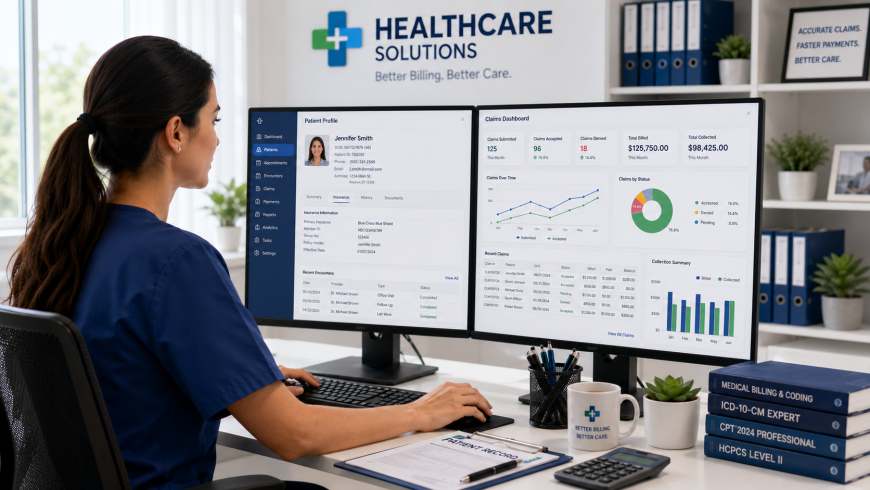
The medical billing services are built on integrated technology stacks: real-time eligibility verification engines, AI-assisted coding tools, automated claim scrubbing software, and analytics dashboards that surface denial trends before they become revenue problems. Despite this, the American Hospital Association still reports claim denial rates averaging 10–15% nationally — evidence that technology adoption in billing is uneven.
This guide examines how technology-driven medical billing services work, what automation actually changes at each step of the billing cycle, and how to evaluate whether your current billing operation is leveraging the tools available to it.
What a Technology-Enabled Billing Service Includes
At its simplest, medical billing is the process of translating the care you provide into an insurance claim — and then doing whatever it takes to make sure that claim gets paid. In practice it involves dozens of steps, multiple systems, and constant attention to payer-specific rules that change regularly.
Professional medical billing services take this entire process off your plate — from verifying a patient's insurance before their appointment to posting the final payment. The goal is to get you paid accurately and on time, while freeing your staff to focus on patients rather than paperwork.
Most billing companies handle:
• Patient eligibility verification before every appointment
• Medical coding using ICD-10-CM and CPT code sets
• Charge capture and entry into your billing system
• Electronic claim submission through certified clearinghouses
• Payment posting and reconciliation
• denial management and claims follow-up
• Accounts receivable (AR) tracking and reporting
Some also offer provider credentialing, prior authorization support, and patient statement management — which is what we do at AcerHealth to give practices a genuinely end-to-end solution.
The Billing Process — Transformed by Technology
Every step of the billing cycle looks different when technology is applied correctly. Here's how automation changes execution at each stage.
Step 1: Patient registration and insurance verification
Before a patient even walks in the door, the billing process has already started. Verifying insurance eligibility and coverage upfront prevents the most common source of denials — discovering after the appointment that the patient's plan doesn't cover the service, or that information was entered incorrectly.
Step 2: Medical coding
Every diagnosis and procedure needs to be translated into standardized codes. Coding accuracy is critical — a single wrong modifier can result in a claim paying at the wrong rate, or not at all. Our certified medical coding team includes specialists who know the nuances of your specialty.
Step 3: Charge entry
Once coding is complete, services are entered into the billing system with the associated fees, modifiers, and facility charges needed for accurate reimbursement.
Step 4: Claim submission
Claims go out electronically through a clearinghouse, which checks them for errors before they reach the payer. Clean claims — ones that pass these initial checks — get processed faster and have a significantly higher first-pass acceptance rate.
Step 5: Payment posting
When the insurer pays, that payment gets posted against the original claim and any remaining patient balance is identified. This step also catches underpayments — where the insurer paid less than the contracted rate — through our contract compliance monitoring.
Step 6: Denial management and follow-up
When a claim is denied, the billing team reviews the reason, corrects the issue, and resubmits within the payer's appeal window. This is where a lot of revenue gets lost in practices without dedicated billing staff — denials get set aside and eventually written off rather than worked.
The Financial Impact of Technology-Driven Billing
The financial case for technology-enabled billing is quantifiable across each stage of the revenue cycle:
Faster, more predictable reimbursements
When billing is managed by people who do nothing else, claims go out faster and follow-ups happen consistently. Most practices that switch to outsourced billing see their average days in AR drop within the first 90 days.
Lower denial rates
MGMA data shows that in-house billing costs practices an average of 13.7% of net collections, compared to around 5.4% for outsourced billing — partly because of higher denial rates and write-offs when billing isn't the primary focus. Experienced billing teams typically achieve first-pass claim acceptance rates above 95%.
No more staffing headaches
Hiring, training, and retaining billing staff is expensive and time-consuming. When your biller leaves, your revenue cycle management doesn't stop — but your ability to manage it does. Outsourcing eliminates that single point of failure.
Compliance without the stress
Billing regulations change constantly — coding updates, payer policy changes, CMS rule revisions. A good billing company stays current on all of it, meaning fewer audit risks and no surprises, while maintaining HIPAA compliance.
Real visibility into your financials
Modern medical billing services provide regular reporting on collection rates, denial rates, aging AR, and payer performance — giving you the numbers you need to make informed decisions.
More time for what matters
When billing is handled, physicians and office managers get hours back every week — time that goes toward patients, not paperwork.
In-house vs. Outsourced Technology Capabilities
The right choice depends on your practice size, current team, and what's actually happening with your revenue. Here's the comparison clearly:
|
Factor |
In-house billing |
Outsourced billing |
|
Control |
Direct oversight within your practice |
Managed by an external billing team |
|
Expertise |
Depends on internal staff experience |
Access to specialized billing professionals |
|
Denial management |
May be inconsistent without dedicated focus |
Structured processes with active follow-up |
|
Scalability |
Limited by staff capacity |
Easily adapts to patient volume |
|
Continuity |
Affected by staff turnover |
Stable processes with no single point of failure |
|
Compliance |
Requires ongoing internal effort |
Managed by teams focused on healthcare compliance |
|
Reporting |
Often varies by system or staff |
Standardized reporting and performance tracking |
The technology gap between in-house and outsourced billing operations is often more significant than the staffing difference. Enterprise-grade claim scrubbing software, real-time eligibility engines, and analytics-driven denial management platforms carry significant implementation and maintenance costs — costs that are spread across a billing company's client base, making them accessible to individual practices at a fraction of the standalone price.
Common Billing Technology Gaps That Cost Practices Revenue
Across practices that rely on manual billing processes, the same technology gaps produce the same revenue losses:
Claim denials that pile up and never get worked
Denials don't disappear on their own. In practices without a dedicated follow-up process, denied claims get pushed aside and written off — often unnecessarily. The typical practice loses 1–3% of net revenue to claims that were fully recoverable.
Coding errors that quietly cost you
Wrong codes, missing modifiers, outdated code sets — these mistakes often don't surface as outright rejections. Instead, claims get underpaid and the difference accumulates unnoticed. A coding audit frequently reveals significant recoverable revenue.
Eligibility issues discovered after the appointment
Checking insurance eligibility at the time of service — rather than before the appointment — is one of the most common process gaps we find. By the time the claim is denied for coverage issues, the patient has already left, and collecting becomes much harder.
Falling behind on payer rule changes
CMS and Medicaid policies vary by state and change throughout the year. Commercial payers update fee schedules and documentation requirements regularly. In-house teams often simply don't have the bandwidth to keep up with all of it.
High staff turnover in billing roles
Medical billing is a skilled job with a high turnover rate. When a key billing staff member leaves, it can take weeks or months to hire and train a replacement — during which time claims may go out late, follow-ups fall behind, and denials accumulate.
Compliance risks that sneak up on you
HIPAA violations, improper coding under Medicare, upcoding or under-coding — these aren't abstract risks. Practices that lack proper HIPAA compliance oversight can face audits, recoupments, and significant financial penalties. The best protection is a billing process built around compliance from the start.
What to Look for in a Technology-Enabled Billing Partner
Not all billing companies have invested equally in technology. When evaluating a partner specifically for their technology capabilities, ask:
Do they know your specialty?
Ask specifically about their experience with your specialty — not just whether they've billed for it, but what their denial rate looks like for practices similar to yours. Ask to see sample reports from comparable clients.
How do they handle denials?
Denial management is where the real work happens and where billing companies most often fall short. Ask: What's your average denial rate for practices like mine? How quickly do you appeal a denial? What percentage of denials do you recover? A billing company that can't answer these questions clearly probably doesn't have a strong denial management process.
What does your pricing include?
Percentage-of-collections pricing is standard, but what's included varies. Some companies charge extra for credentialing, prior auth support, or patient billing services. Understand exactly what you're paying for before you sign anything.
How will you see your data?
You should have access to a real-time dashboard or at minimum regular reports showing your key metrics: days in AR, first-pass claim acceptance rate, denial rate by payer, and collection rate. If a billing company can't give you this visibility, that's a red flag.
What does onboarding look like?
Switching billing companies involves transferring data, credentialing updates, and workflow changes. A good billing partner will have a structured onboarding process with clear timelines and dedicated support.
Are they actually HIPAA-compliant?
HIPAA compliance isn't optional, and it goes beyond signing a Business Associate Agreement. Ask about their data security practices, how they handle PHI, and whether they've had any breach incidents.
Technology Has Changed What's Possible in Medical Billing
Practices that leverage modern billing technology — automated eligibility verification, AI-assisted coding, pre-submission claim scrubbing, analytics-driven denial management — consistently achieve better financial outcomes than those that rely on manual processes. The gap is widening. AcerHealth's billing platform integrates all of these capabilities into a connected system designed to maximize collection performance.
Frequently Asked Questions
What do medical billing services actually cost?
Most providers charge between 3% and 8% of net collections, depending on your practice size and specialty. Some use flat-fee-per-claim models instead. At AcerHealth, we work with each practice to find a pricing structure that reflects the actual scope of work — because the range of services included can vary significantly between companies.
How long does it take to see results after switching to outsourced billing?
Most practices see measurable improvement within 60–90 days. The first month is typically focused on onboarding and getting claims flowing correctly. By month two, denial rates usually start to improve as the billing team learns your payer mix. By month three, you should have clear reporting and a solid baseline to compare against.
Will I lose control of my billing if I outsource?
This is the concern we hear most often. A good billing company gives you more visibility into your billing process, not less — with real-time reporting, regular performance reviews, and direct lines of communication with your billing team. Outsourcing doesn't mean handing over control; it means having a dedicated team accountable for results.
Is outsourced billing secure and HIPAA-compliant?
Any reputable billing company will sign a Business Associate Agreement with your practice, which is required under HIPAA compliance. Beyond that, ask about their data security practices, employee training on PHI handling, and breach history.
Can a billing company handle my specific specialty?
Specialty matters more than many providers realize. At AcerHealth, we work across more than 15 specialties — including mental health, cardiology, dermatology, physical therapy, and primary care — with certified coders trained in specialty-specific CPT and ICD-10-CM requirements.