Synthetic Leather Market Global Industry Outlook to 2035
Explore the Synthetic Leather Market projected to grow from US$56.0 billion in 2025 to US$142.3 billion by 2035, registering a CAGR of 9.8%. https://market.us/report/synthetic-leather-market/
 sonicbolt20
Overview
The Synthetic Leather Market generated US$56.0 billion in 2025 and is expected to reach approximately US$142.3 billion by 2035, registering a CAGR of 9.8% during 2026–2035. In 2025, Asia Pacific led the global market by securing more than 46.8% share with revenue of US$26.21 billion. Market expansion is being driven by growing demand for synthetic leather across automotive, footwear, furniture, and fashion industries, supported by innovations in sustainable coatings, recycled textile backings, and bio-based material development.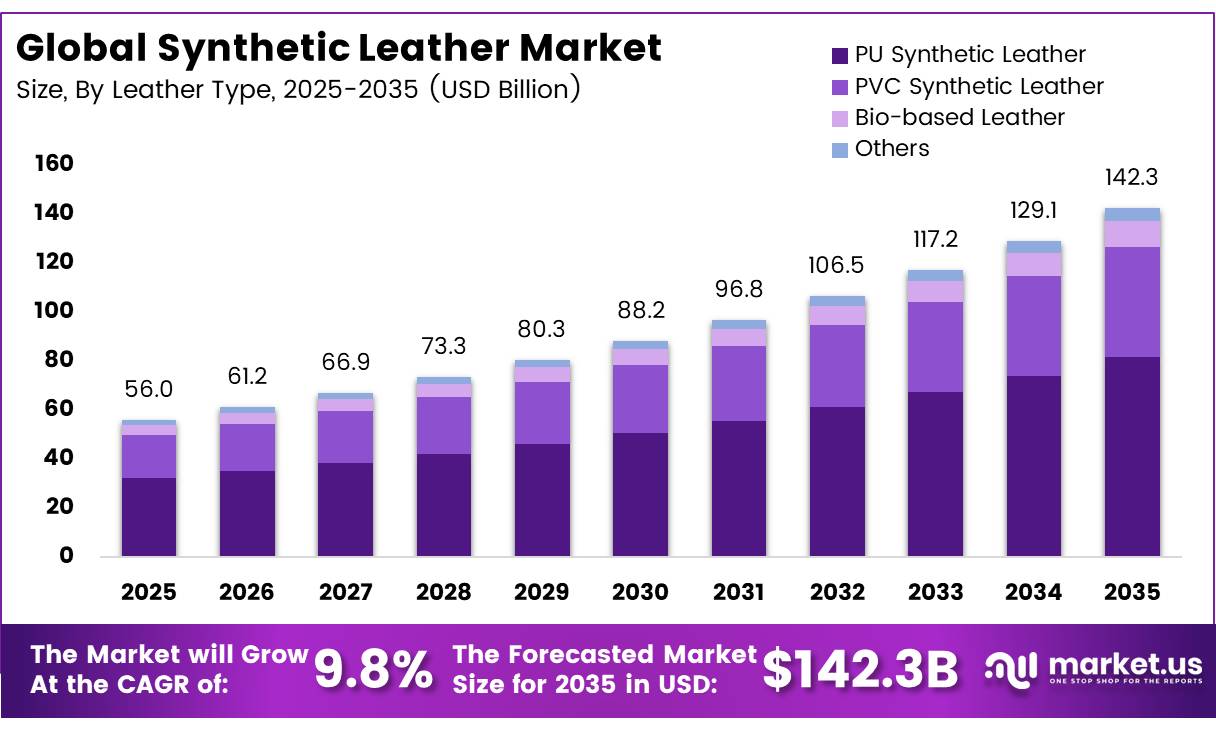
Key Takeaways
- The global Synthetic Leather Market was valued at US$56.0 billion in 2025.
- The market is projected to reach US$142.3 billion by 2035, registering a CAGR of 9.8% during 2026–2035.
- PU Synthetic Leather dominated the leather type segment with 57.3% market share in 2025.
- The Automotive segment accounted for 30.4% of the global market by end use in 2025.
- Direct procurement led the distribution channel segment with a 63.4% share.
- Asia Pacific remained the leading regional market, accounting for 46.8% of global consumption in 2025.
Leather Type Analysis
PU Synthetic Leather represented the dominant segment, accounting for 57.3% of the global market in 2025. Its leadership is supported by an effective combination of durability, flexibility, softness, breathability, and attractive appearance across multiple industries. The material is widely used in automotive interiors, footwear, furniture, fashion accessories, and upholstery because it delivers consistent performance while maintaining cost efficiency.
Compared with PVC-based alternatives, PU Synthetic Leather provides greater comfort, enhanced flexibility, and a relatively lower environmental impact. Ongoing developments in water-based and solvent-free polyurethane technologies continue to improve its sustainability profile while meeting the performance requirements of manufacturers seeking high-quality synthetic materials.
The Bio-based Leather segment is projected to register the fastest growth over the forecast period. Increasing investments in sustainable material alternatives, along with innovations utilizing plant-based feedstocks, agricultural waste, and mycelium, are improving commercial viability. These developments are enabling bio-based leather to gain greater acceptance across premium fashion, automotive, and lifestyle applications.
Distribution Channel Analysis
The Direct distribution channel accounted for 63.4% of the Synthetic Leather Market in 2025, reflecting the preference of major manufacturers for long-term supplier relationships. Direct procurement enables companies to secure consistent product quality, stable pricing, customized material specifications, and reliable product availability across high-volume manufacturing operations.
Industries such as automotive, footwear, furniture, and fashion increasingly work directly with synthetic leather manufacturers to obtain technical support and greater supply chain transparency. This procurement approach also strengthens production planning, enhances quality control, and minimizes procurement risks, making direct sourcing the preferred model for large industrial buyers.
The Indirect distribution channel is expected to experience the fastest growth as small and medium-sized manufacturers increasingly rely on distributors and digital sourcing platforms. Expanding e-commerce availability, flexible order quantities, localized inventory, and value-added distribution services allow businesses to reduce procurement complexity while responding more efficiently to changing customer preferences.
End Use Analysis
The Automotive segment held the leading position with 30.4% of the global market in 2025. Vehicle manufacturers increasingly prefer synthetic leather because it combines durability, lightweight characteristics, consistent quality, and attractive interior aesthetics. The material also supports sustainability initiatives by reducing dependence on animal-derived products while offering excellent design flexibility and scalable manufacturing.
Growing production of electric vehicles and premium passenger vehicles continues to strengthen synthetic leather adoption across automotive interiors. In May 2026, Škoda Auto introduced the Škoda Epiq electric SUV featuring premium synthetic leather upholstery in higher variants alongside interior materials made from 100% recycled polyester, demonstrating the increasing role of sustainable materials in electric vehicle design.
The Footwear segment is anticipated to record the fastest growth during the forecast period. Manufacturers are increasingly utilizing synthetic leather to produce lightweight, durable, affordable footwear that appeals to a broad consumer base. Rising demand for athletic, casual, and fashion footwear, together with growing consumer awareness of cruelty-free materials, continues to support market expansion. Product innovations, improved moisture resistance, enhanced comfort, and expanding online retail channels further contribute to increasing adoption.
Key Market Segments
By Leather Type
- PU Synthetic Leather
- PVC Synthetic Leather
- Bio-based Leather
- Others
By Distribution Channel
- Direct
- Indirect
By End User
- Automotive
- Footwear
- Furnishing
- Clothing
- Bags
- Purses & Wallets
- Others
Driving Factors
The growing shift from natural leather toward synthetic alternatives remains one of the strongest long-term growth drivers for the Synthetic Leather Market. Increasing emphasis on sustainability, animal welfare, and resource efficiency is transforming purchasing decisions across the fashion, automotive, and furniture industries. As major brands adopt animal-free and leather-free commitments for selected product lines, demand for synthetic materials continues to expand.
This transition is encouraging manufacturers to move beyond low-cost commodity production toward higher-value sustainable materials featuring traceability, life-cycle assessment verification, and bio-based innovations. Expansion in footwear, athleisure, fashion accessories, automotive interior upgrades, electric vehicle production, emerging market urbanization, and increasing ESG procurement standards further reinforce long-term market growth.
Restraining Factors
Environmental concerns associated with conventional PVC and PU synthetic leather production remain a significant challenge for market participants. Regulatory scrutiny surrounding volatile organic compounds, hazardous solvents such as N,N-dimethylformamide (DMF), and worker safety requirements is increasing across major developed markets.
Manufacturers are required to invest in waterborne polyurethane technologies, solvent-free coating systems, alternative plasticizers, and advanced emission control equipment to comply with evolving environmental regulations. At the same time, producers must continue operating existing production lines while transitioning toward newer technologies, increasing capital expenditure and operational costs. Additional challenges include dependence on fossil-based feedstocks, microplastic concerns, volatile petrochemical prices, price competition from low-cost Asian producers, and consumer perceptions regarding the performance of synthetic leather compared with natural leather.
Growth Opportunity
The development of next-generation bio-based and mycelium hybrid leather platforms presents a significant long-term opportunity for the Synthetic Leather Market. Although these materials currently remain niche products, they align with growing demand for animal-free, low-water, and reduced fossil-content materials across premium consumer markets.
Conventional synthetic leather already offers substantial reductions in water consumption compared with chrome-tanned leather, while emerging plant-based, mycelium, and bio-based polyurethane materials have the potential to deliver additional environmental benefits as production scales improve. These advanced materials are currently targeted toward luxury footwear, handbags, and premium lifestyle products, where higher selling prices support commercialization. As manufacturers build integrated next-generation leather platforms supported by sustainability certifications and life-cycle assessment data, opportunities are expected to expand into luxury fashion, automotive interiors, and electronics applications, creating new premium revenue streams over the long term.