Sustainable Infrastructure Investments Support Wind Energy Industry Expansion
The primary industry participants are collaborating and acquiring suppliers of raw materials and component manufacturers to reduce the overall cost of wind energy projects.
 straits23
Clean Energy Transition Reshapes Global Power Generation
The global energy landscape is undergoing a significant transformation as countries work to reduce carbon emissions and strengthen energy security. Renewable energy technologies have become central to these efforts, with wind power emerging as one of the fastest-growing sources of clean electricity generation worldwide.
Wind energy harnesses the kinetic energy of moving air to generate electricity through onshore and offshore wind turbines. Advances in turbine technology, supportive government policies, and declining generation costs have made wind power an increasingly attractive alternative to conventional fossil-fuel-based energy sources.
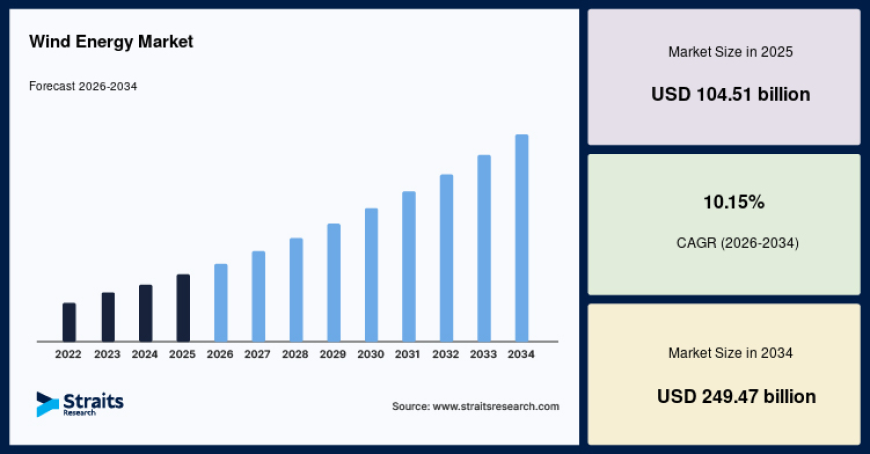
The global wind energy market was valued at USD 104.51 billion in 2025 and is projected to grow from USD 115.12 billion in 2026 to USD 249.47 billion by 2034, registering a CAGR of 10.15% during the forecast period (2026–2034).
Growing commitments to net-zero emissions, expanding renewable energy targets, and increasing investments in grid modernization are expected to support robust market growth over the coming decade.
Global Decarbonization Goals Drive Market Momentum
Governments across the world are implementing ambitious climate strategies aimed at reducing dependence on fossil fuels. Wind energy has become a critical component of these plans due to its ability to generate large-scale electricity without direct greenhouse gas emissions.
National renewable energy targets, carbon neutrality commitments, and clean energy incentives are encouraging both public and private sector investments in wind power projects. As environmental regulations become more stringent, wind energy is expected to play an increasingly important role in global electricity generation.
Many countries are also focusing on energy independence, further strengthening support for domestic renewable energy infrastructure development.
Offshore Wind Emerges as a High-Growth Segment
Increasing Investment in Offshore Projects
Offshore wind farms are attracting substantial investments due to their ability to generate higher and more consistent energy output compared to many onshore installations. Technological advancements are enabling developers to deploy larger turbines capable of producing greater amounts of electricity.
The expansion of offshore projects is creating new opportunities for turbine manufacturers, component suppliers, and engineering service providers.
Floating Wind Technology Advances
Floating wind platforms are emerging as a promising solution for harnessing wind resources in deep-water environments. These technologies allow developers to access locations previously unsuitable for conventional fixed-bottom installations.
As commercialization efforts continue, floating wind projects are expected to contribute significantly to future market growth.
Technological Innovations Enhance Efficiency
Larger and More Powerful Turbines
Manufacturers are developing next-generation wind turbines with greater capacity, improved efficiency, and enhanced reliability. Larger rotor diameters and taller towers enable increased energy capture and improved project economics.
Digital Monitoring and Predictive Maintenance
Artificial intelligence, machine learning, and IoT technologies are transforming wind farm operations. Advanced monitoring systems enable operators to predict equipment failures, optimize maintenance schedules, and improve overall performance.
Smart Grid Integration
The integration of wind energy into modern smart grids is helping utilities manage renewable power generation more effectively while enhancing grid stability and reliability.
For Detailed Insights, Visit:
https://straitsresearch.com/report/wind-energy-market
Investment Opportunities Across the Value Chain
Utility-Scale Wind Farms
Large-scale wind projects continue to attract investments from governments, utilities, and institutional investors seeking long-term sustainable energy assets.
Manufacturing and Supply Chain Expansion
Growing global demand for wind turbines is encouraging manufacturers to expand production capacity and strengthen supply chain networks.
Energy Storage Integration
The increasing deployment of battery storage systems alongside wind farms is improving grid flexibility and enabling more efficient utilization of renewable energy resources.
Corporate Renewable Energy Procurement
Businesses across multiple industries are entering long-term power purchase agreements (PPAs) to secure renewable electricity and meet sustainability objectives.
Challenges Affecting Market Development
High Initial Capital Requirements
Wind energy projects require significant upfront investments in infrastructure, equipment, and grid connectivity, which can create financing challenges.
Grid Infrastructure Limitations
Many regions require substantial upgrades to transmission and distribution networks to accommodate increasing renewable energy capacity.
Supply Chain Constraints
Growing demand for turbines, rare earth materials, and specialized components can create supply chain bottlenecks and impact project timelines.
Regulatory and Permitting Delays
Complex permitting processes and local opposition can slow project development and increase costs for developers.
Regional Growth Landscape
Asia-Pacific remains the largest and fastest-growing market for wind energy, driven by substantial investments in renewable energy projects across China, India, and other emerging economies.
Europe continues to lead offshore wind deployment, supported by ambitious climate goals and strong government incentives promoting renewable energy adoption.
North America remains a key market due to expanding renewable energy portfolios, corporate sustainability initiatives, and favorable policy frameworks.
Meanwhile, Latin America and the Middle East & Africa are increasingly investing in wind power infrastructure to diversify energy sources and support economic development.
Future Industry Outlook
The future of the wind energy market will be shaped by advancements in turbine design, digital technologies, energy storage integration, and offshore wind development. As renewable energy costs continue to decline, wind power is expected to become an even more competitive source of electricity generation.
Emerging technologies such as floating offshore wind platforms, AI-driven asset management systems, and hybrid renewable energy projects will create new opportunities across the industry. Governments and corporations are also expected to increase investments in clean energy infrastructure as sustainability goals become more aggressive.
With global demand for low-carbon energy solutions continuing to rise, wind energy is positioned to remain a cornerstone of the global energy transition for decades to come.
Competitive Landscape
The wind energy market remains highly competitive, with industry participants focusing on technological innovation, production capacity expansion, and strategic partnerships.
Major companies operating in the market include:
Vestas Wind Systems A/S
Siemens Gamesa Renewable Energy S.A.
GE Vernova
Nordex SE
Goldwind Science & Technology Co., Ltd.
Envision Energy
Suzlon Energy Limited
MingYang Smart Energy Group Co., Ltd.
Enercon GmbH
Senvion GmbH
These companies continue to invest in advanced turbine technologies, offshore wind solutions, and digital optimization platforms to strengthen their competitive positions.
Related Insights
Renewable Energy Market
https://straitsresearch.com/report/renewable-energy-market
Offshore Wind Energy Market
https://straitsresearch.com/report/offshore-wind-energy-market
About Us
Straits Research is a leading market intelligence and consulting organization specializing in industry analysis, business forecasting, and strategic market research solutions. The company delivers actionable insights that help organizations identify growth opportunities and make informed business decisions.
Contact Us
Email: [email protected]
Tel: +1 646 905 0080 (U.S.)
Tel: +44 203 695 0070 (U.K.)