Soda Ash Market Strategic Analysis Covering Trends, Segments, and Regional Developments
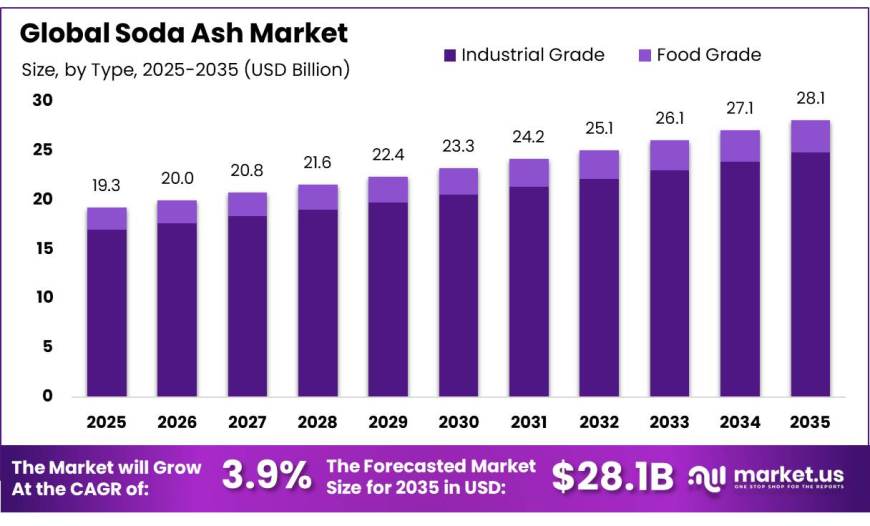
Soda Ash Market was valued at USD 19.3 billion in 2025 and is projected to reach USD 28.1 billion by 2035, growing at a CAGR of 3.9% https://market.us/report/soda-ash-market/
 sonicbolt20
Overview
Soda Ash Market is positioned for long-term expansion, increasing from USD 19.3 billion in 2025 to USD 28.1 billion by 2035 at a 3.9% CAGR between 2026 and 2035. Asia Pacific was the leading market in 2025, capturing over 40.6% share and revenue of USD 7.83 billion. Market growth is influenced by demand for natural soda ash, solar glass, and lithium carbonate processing. In 2025, Tata Chemicals’ Mithapur facility produced 1 million tonnes in FY2025–26, while the U.S. industry maintained 13.9 million metric tons per year capacity through 6 plants owned by 5 companies.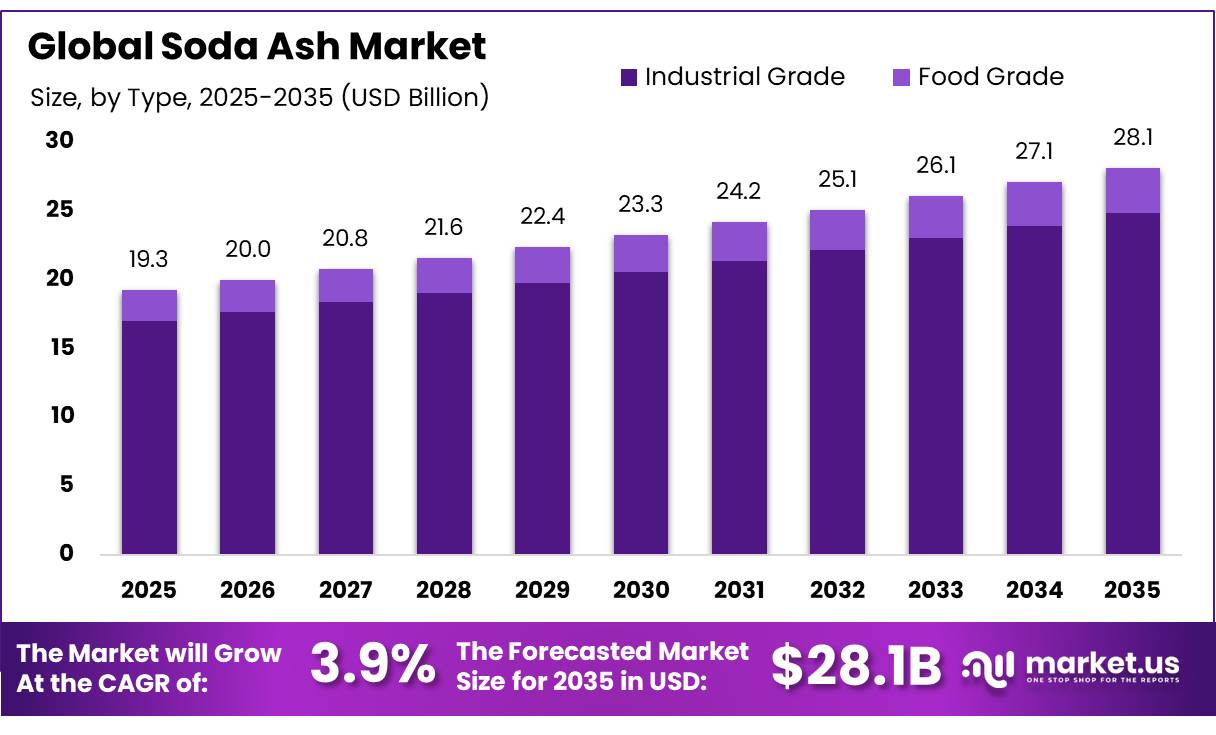
Key Takeaways
- The soda ash market was valued at US$ 19.3 billion in 2025 and is projected to grow at a CAGR of 3.9%, reaching US$ 28.1 billion by 2035.
- Natural Soda Ash dominates the source segment with a 58.4% share due to lower production costs, reduced energy consumption, and lower environmental impact compared with synthetic alternatives.
- Dense Soda Ash leads the product type segment with a 47.8% share, supported by strong demand from heavy industrial processes requiring high-strength granular material.
- Industrial Grade holds the largest quality grade segment position with an 88.3% share because of its extensive use in glass manufacturing, chemical production, metal processing, and other industrial applications.
- Glass Manufacturing represents the leading application segment with a 52.6% share, driven by demand for flat glass, container glass, fibreglass, and solar photovoltaic glass.
- Asia Pacific remains the dominant regional market, accounting for a 40.6% share of the soda ash market.
Analysis Sections
Type Analysis
Natural Soda Ash represents the dominant segment in the soda ash market with a 58.4% share. Its leadership is supported by lower energy requirements and reduced greenhouse gas emissions compared with synthetic production methods. Natural trona processing requires fewer chemical transformation steps, helping producers manage production costs during periods of high electricity and fuel prices.
Large-scale trona deposits in Wyoming’s Green River basin provide producers with significant cost advantages due to accessible reserves and efficient mining operations. These advantages allow natural soda ash suppliers to maintain competitive positions in export markets. Growing preference among manufacturers for lower-carbon supply chains further strengthens the adoption of natural soda ash across global industries.
Product Type Analysis
Dense Soda Ash is the leading product type, accounting for a 47.8% share of the market. Its coarse granular structure makes it suitable for large-scale industrial operations where reduced dust generation, efficient handling, and consistent processing performance are required.
Dense Soda Ash remains widely used in applications such as construction materials and container manufacturing because of its ability to support reliable high-temperature industrial processes. Demand for specialised soda ash products is also increasing, with ultra-pure light soda ash gaining attention for concentrated consumer products and detergent applications between 2030 and 2035.
Grade Analysis
Industrial Grade dominates the soda ash market with an 88.3% share due to its essential role in major manufacturing activities. It is widely used in flat glass production, container glass manufacturing, metal processing, and chemical production because these industries require large volumes of reliable raw materials without the extensive purification requirements needed for specialised grades.
Battery-cathode grade sodium carbonate is emerging as an important growth area between 2030 and 2035 due to increasing electric vehicle and energy storage demand. This application requires high purity levels, with battery manufacturers requiring impurities below 99.5%, encouraging suppliers to invest in advanced refining capabilities.
Application Analysis
Glass Manufacturing is the largest application segment, representing 52.6% of the soda ash market. Soda ash plays a critical role in glass production by lowering the melting temperature of silica, improving energy efficiency, and supporting efficient glass formation.
Demand from flat glass, container glass, fibreglass, and solar glass industries continues to support market growth. Expansion of construction, automotive manufacturing, packaging, and solar photovoltaic installations is increasing soda ash consumption. Lithium carbonate precipitation for energy storage systems is also becoming a significant demand opportunity, as approximately two metric tons of sodium carbonate are required to produce one metric ton of lithium carbonate used in batteries.
Key Market Segments
By Type
Natural Soda Ash
Synthetic Soda Ash
By Product Type
- Light Soda Ash
- Dense Soda Ash
- Washing Soda
- Baking Soda
- Others
By Grade
- Industrial Grade
- Food Grade
By Application
- Glass Manufacturing
- Soaps & Detergents
- Chemicals Manufacturing
- Water Treatment
- Pulp & Paper
- Metallurgy
- Textile Processing
- Food & Beverage
- Pharmaceuticals
- Agriculture
- Others
Driving Factors
Glass manufacturing remains the primary structural driver for soda ash demand, accounting for approximately 51–57% of worldwide consumption. Soda ash works as a fluxing agent by reducing the melting temperature of silica from nearly 1,700°C to a commercially manageable range of 1,200–1,500°C.
Construction growth across South and Southeast Asia and the Gulf is supporting architectural glass demand, while automotive manufacturing recovery is increasing demand for vehicle glass applications. Each vehicle contains glass requiring an estimated 3.5–5 kg of soda ash equivalent.
The expansion of solar photovoltaic installations is also strengthening demand for solar glass production. Additionally, restrictions on disposable plastic packaging and increasing adoption of recyclable glass formats across more than 70 countries are supporting container glass demand.
Restraining Factors
Persistent Chinese oversupply is the major restraint affecting soda ash market performance. Domestic spot prices in China declined by 18.19% during 2025, decreasing from RMB 1,528 per ton at the beginning of the year to RMB 1,250 per ton by year-end.
China contributes close to half of global production and consumption, making capacity additions highly influential on international pricing conditions. New low-cost production facilities have expanded faster than downstream demand, creating pricing pressure across the industry.
Global consumption increased by only 1.2%, equal to approximately 800,000 metric tons, after an 8% expansion in the previous year. This imbalance is creating challenges for European synthetic producers, where production costs can reach EUR 180–220 per ton. Market prices below EUR170perton may push higher-cost facilities into negative operating cash flow.
Growth Opportunity
The sodium-ion battery supply chain creates a new growth opportunity for soda ash producers by expanding demand beyond traditional glass and detergent applications. The sodium-ion battery sector was valued at USD 1.39 billion in 2025 and is projected to reach USD 7.81 billion by 2035, growing at an 18.84% CAGR.
Sodium carbonate is used in layered metal oxide and Prussian blue analogue cathode chemistries, while approximately 1.10 kg of soda ash is required to produce one kilogram of battery-grade lithium carbonate. Producers supplying material with at least 99.8% Na₂CO₃ purity and heavy-metal content below 5 ppm could achieve premiums of USD 80–150 per ton.
Additional opportunities include solar glass supply chain integration, green and low-carbon soda ash production, greenfield capacity development, mergers and acquisitions among mid-tier producers, and pharmaceutical and high-purity soda ash applications.
The sodium-ion battery opportunity could contribute a +1.8% potential CAGR upside, while solar glass supply chain integration may provide +1.5% potential CAGR upside. Green and low-carbon soda ash segments may contribute +1.2%, MEA and Sub-Saharan Africa greenfield capacity buildout +1.0%, M&A roll-up strategies +0.9%, and pharmaceutical and high-purity soda ash applications +0.7%.