The Second-Click Problem: What Happens After Google Answers the Searcher?
AI Overviews answer searches instantly—so what earns the click after that? Learn how to win the second click with content that goes deeper than AI
 boultjames
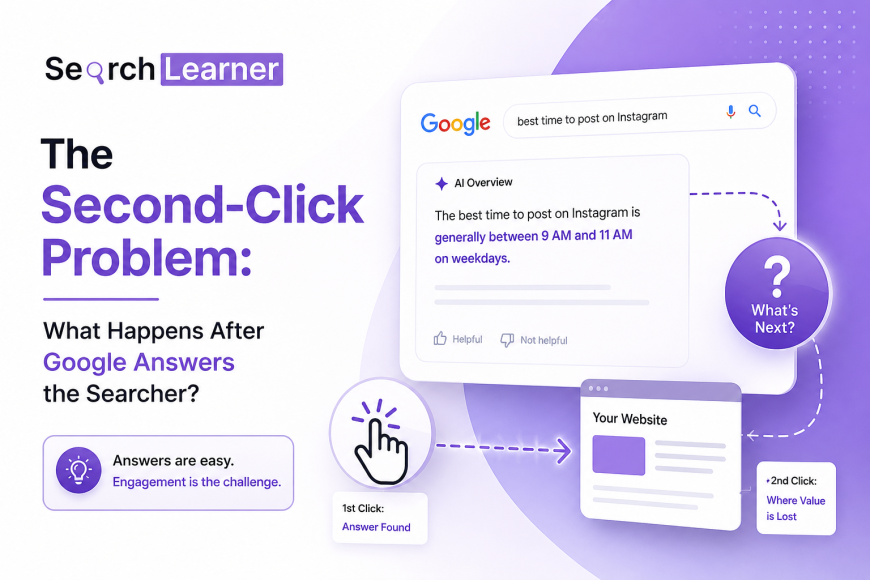
Search used to end with a click. Now it often ends with an answer, and the click never happens. AI Overviews and AI Mode are settling queries right on the results page, which means brands that once counted on that first click are losing it before a visitor ever reaches their site. But the story doesn’t stop there. Some searchers still want more than a summary, and figuring out what makes them click a second time is the real opportunity. This piece looks at why that second click matters, who earns it, and how Search Learner would approach building content for it.
Curious how AI Overviews are reshaping your traffic? Search Learner’s SEO section tracks these shifts weekly.
Why the First Click Isn’t Guaranteed Anymore
A growing share of searches get resolved without anyone leaving the results page. The searcher reads a summary, gets a name, a date, or a quick fix, and moves on. Google has even said its AI features send billions of clicks weekly, though publishers argue those numbers don’t tell the full story on a per-site basis. Either way, the days of assuming every ranking meant a visit are over. Content built purely to answer a single fact is the most exposed, since a snippet or summary can lift that answer without sending anyone further. This is the shift Search Learner keeps flagging: visibility and traffic are no longer the same metric, and treating them as interchangeable is how teams get blindsided by falling sessions despite stable rankings.
Want the full picture on where your clicks are actually going? Search Learner breaks down how to track AI Overview traffic in GSC vs GA4.
What Actually Earns the Second Click
If the first answer satisfies curiosity, the second click has to satisfy something deeper, proof, nuance, or a next step the summary can’t offer. That usually means original data, a worked example, a comparison the AI can’t neatly compress, or a tool the reader wants to use directly. Generic explainer content rarely survives this filter anymore, because a model already generates something similar in seconds. Search Learner’s own reporting on original research suggests the same conclusion from another angle: content that includes something citable, something the AI itself has to reference rather than paraphrase, tends to hold its ground. The pattern is consistent across formats. Depth, specificity, and a reason to keep reading are what separate a page that gets bypassed from one that gets opened.
For a deeper look at what content formats still pull clicks, check Search Learner’s research on why AI search favors original citations.
Rethinking Content Strategy for a Post-Answer World
Publishers can’t undo AI Overviews, but they can change what they publish. That starts with auditing which pages exist only to answer a single query and asking whether that answer alone was ever going to justify a visit. Pages built around interactive tools, calculators, first-party data, or genuine opinion tend to outperform pure definitions. Structure matters too, a page that front-loads the quick answer and then earns the click with detail underneath respects both the AI summarizer and the human reader. It’s a shift from writing for rank to writing for a reason to stay. Teams that treat this as a content-design problem, not just a technical SEO one, are adapting faster than the ones still chasing keyword volume alone.
Ready to rework a content strategy around this shift? Search Learner’s guide on AI search and LLM optimization strategies is a solid starting point.
Measuring Success Beyond Rankings
Ranking position is no longer proof of performance, so teams need new ways to judge whether content is working. That means watching impressions against clicks in Search Console, separating branded from informational query performance, and paying attention to which pages keep earning visits even as summaries answer the surface-level version of the question. A page that ranks but never gets opened is telling you something different than a page that ranks and converts. Analytics setups that only track sessions miss half the picture; the other half is understanding what searchers were shown before they decided your page was worth a click. That distinction is becoming central to how content decisions get made.
Not sure your analytics setup captures this? Search Learner’s Analytics section has practical breakdowns worth a look.
Conclusion
The second-click problem isn’t going away, and treating it as a temporary disruption is a mistake. Searchers still want proof, depth, and tools beyond a summary, brands just have to earn that click more deliberately now. Search Learner has been tracking this shift closely, and the sites adapting fastest are the ones asking why someone should click, not just how to rank. That question is worth answering before writing another page.