Reducing Regulatory Reporting Errors Through Automated BRF Reporting
Discover how automated BRF reporting helps banks reduce regulatory reporting errors, improve data accuracy, strengthen compliance, and streamline reporting processes.
 kellyhamisha
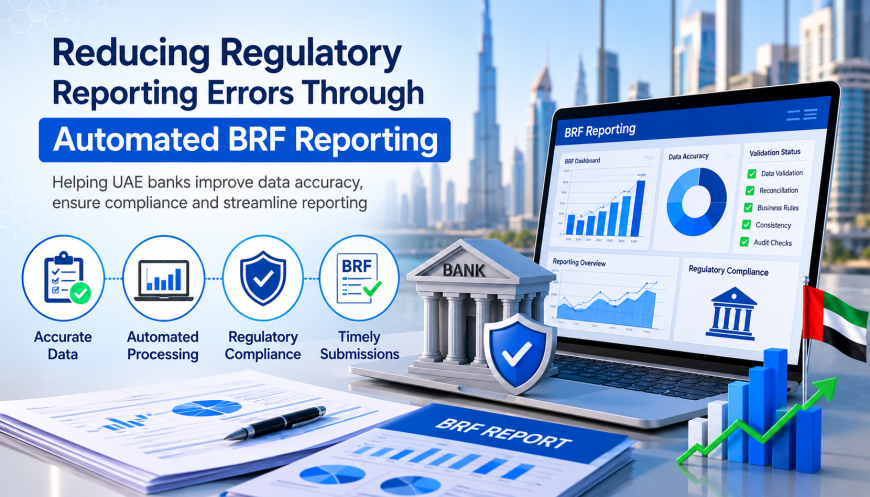
Regulatory reporting plays a vital role in maintaining the stability, transparency, and integrity of the banking sector. As BRF reporting UAE banks must comply with becomes increasingly detailed and data-intensive, financial institutions are under growing pressure to deliver accurate, timely, and compliant submissions to regulators. However, managing large volumes of data across multiple systems while meeting strict reporting deadlines can create significant operational challenges. Manual reporting processes often increase the risk of errors, inconsistencies, and compliance concerns. To address these challenges, many banks are turning to automated BRF reporting solutions that improve accuracy, streamline workflows, and strengthen regulatory compliance.
Manual reporting processes often involve collecting information from multiple systems, consolidating datasets, performing reconciliations, validating figures, and preparing reports under strict deadlines. These activities create numerous opportunities for errors that can impact compliance, increase operational costs, and attract regulatory scrutiny.
To address these challenges, many financial institutions are turning to automated BRF reporting solutions. By automating data collection, validation, reconciliation, and report generation, banks can significantly reduce reporting errors while improving efficiency and strengthening compliance frameworks.
The Growing Importance of Accurate Regulatory Reporting
Regulatory reporting is more than a compliance exercise. Regulators rely on reported data to assess the health and stability of financial institutions and the broader banking sector.
Accurate reporting supports:
- Effective regulatory oversight
- Risk monitoring
- Financial stability assessments
- Capital adequacy reviews
- Liquidity supervision
- Prudential compliance
When reports contain inaccuracies, regulators may receive an incomplete picture of a bank's financial condition. Even relatively small reporting errors can lead to regulatory inquiries, remediation efforts, additional audits, and reputational concerns.
As supervisory expectations continue to evolve, reporting accuracy has become a strategic priority for financial institutions.
Why Regulatory Reporting Errors Occur
Despite substantial investments in reporting processes, many banks continue to face recurring reporting challenges.
The root causes are often linked to operational complexity rather than a lack of expertise.
Manual Data Collection
Many reporting teams still extract information manually from multiple systems.
Data may be gathered from:
- Core banking platforms
- Finance systems
- Treasury applications
- Risk management solutions
- Operational databases
Each manual transfer increases the possibility of mistakes such as incorrect entries, omitted data, or outdated information.
Spreadsheet Dependency
Spreadsheets remain widely used for regulatory reporting because they offer flexibility and familiarity.
However, spreadsheet-based reporting introduces several risks:
- Formula errors
- Broken references
- Version control issues
- Duplicate files
- Manual adjustments
As reporting requirements become more sophisticated, spreadsheet management becomes increasingly difficult and error-prone.
Data Silos
In many organizations, critical reporting information is stored across separate departments and systems.
Finance, risk, treasury, and operations teams may maintain different datasets and definitions, creating inconsistencies that affect reporting outputs.
Reconciling information across these silos often requires substantial manual effort.
Tight Reporting Deadlines
Regulatory submissions are typically subject to strict timelines.
Reporting teams often work under significant pressure to gather, validate, and submit information quickly. Time constraints can increase the likelihood of oversight and reduce opportunities for thorough review.
What Is Automated BRF Reporting?
Automated BRF reporting refers to the use of technology solutions that streamline the preparation and submission of Banking Return Forms and other regulatory reports.
Rather than relying on manual processes, automated platforms perform many reporting activities through predefined workflows and system integrations.
Key capabilities often include:
- Automated data extraction
- Data transformation and mapping
- Validation controls
- Reconciliation processes
- Workflow automation
- Audit trail management
- Report generation
These capabilities help create a more efficient, controlled, and accurate reporting environment.
Improving Data Accuracy Through Automation
One of the primary benefits of automated BRF reporting is improved data accuracy.
Automation eliminates many of the manual steps that commonly introduce reporting errors. Data can be extracted directly from source systems without requiring repeated handling by multiple users.
This reduces the risk of:
- Typographical mistakes
- Data duplication
- Incorrect calculations
- Missing information
- Inconsistent reporting figures
By establishing automated data flows, banks can create a more reliable foundation for regulatory reporting.
Standardizing Reporting Processes
Inconsistent reporting practices are another common source of errors.
Different teams may apply varying assumptions, methodologies, or data definitions when preparing reports manually.
Automated BRF reporting platforms address this challenge by applying standardized business rules across the reporting process.
Standardization helps ensure:
- Consistent data classification
- Uniform reporting methodologies
- Improved comparability across reports
- Reduced process variability
As a result, institutions can produce more reliable and consistent regulatory submissions.
Automated Validation Controls
Validation is one of the most critical aspects of regulatory reporting.
Traditional reporting environments often depend on manual reviews to identify discrepancies and anomalies. While these reviews remain important, they can be difficult to perform effectively when dealing with large volumes of data.
Automated validation controls continuously assess reporting information against predefined rules.
These controls can identify:
- Missing fields
- Invalid values
- Data inconsistencies
- Out-of-range figures
- Cross-report discrepancies
By detecting issues early, automated validation reduces the likelihood that errors will reach regulators.
Streamlining Reconciliation Activities
Data reconciliation is often one of the most time-consuming reporting tasks.
Banks must ensure that figures reported to regulators align with information held across finance, treasury, risk management, and operational systems.
Manual reconciliation can be labor-intensive and prone to oversight.
Automated BRF reporting solutions simplify reconciliation by continuously comparing information across systems and highlighting discrepancies automatically.
Benefits include:
- Faster identification of issues
- Improved data consistency
- Reduced manual effort
- Enhanced reporting confidence
Automated reconciliation allows reporting teams to focus on resolving genuine issues rather than searching for discrepancies manually.
Enhancing Transparency Through Audit Trails
Regulators increasingly expect banks to demonstrate how reported figures were generated and validated.
Automated reporting platforms provide detailed audit trails that document each stage of the reporting process.
Audit trails typically capture:
- Data origins
- Validation outcomes
- User activities
- Workflow approvals
- Report revisions
This transparency helps institutions respond more effectively to audits, regulatory reviews, and compliance assessments.
Strong audit capabilities also support internal governance and accountability.
Reducing Operational Risk
Regulatory reporting involves numerous interconnected processes.
When these processes depend heavily on manual intervention, operational risk increases.
Automation helps reduce operational risk by minimizing human involvement in repetitive reporting activities.
This leads to:
- Greater process consistency
- Improved reliability
- Lower dependency on individual knowledge
- Enhanced business continuity
Reducing operational risk is particularly important during periods of organizational change, staff turnover, or increased reporting demands.
Improving Reporting Efficiency
In addition to improving accuracy, automated BRF reporting significantly enhances operational efficiency.
Reporting teams often spend large amounts of time collecting, validating, reconciling, and preparing data manually.
Automation streamlines these activities, enabling institutions to:
- Shorten reporting cycles
- Reduce administrative workloads
- Improve resource utilization
- Increase productivity
Rather than focusing on repetitive tasks, reporting professionals can dedicate more time to analysis, governance, and strategic initiatives.
Supporting Regulatory Compliance
Regulatory compliance depends on the ability to produce accurate, complete, and timely reports.
Automated reporting platforms help institutions strengthen compliance by embedding controls directly into reporting workflows.
Benefits include:
- Better adherence to reporting requirements
- Improved submission accuracy
- Enhanced regulatory readiness
- Reduced compliance risk
- Stronger governance frameworks
By improving reporting quality, automation helps build confidence among regulators and internal stakeholders alike.
Preparing for Future Regulatory Requirements
The regulatory environment continues to evolve as supervisors seek greater transparency and more detailed reporting information.
Future reporting requirements are likely to involve:
- Increased reporting frequency
- Greater data granularity
- Enhanced validation standards
- Expanded supervisory expectations
Banks that continue to rely heavily on manual reporting processes may find it increasingly difficult to keep pace with these changes.
Automated BRF reporting provides a scalable foundation that enables institutions to adapt more efficiently to future requirements.
By investing in automation today, banks can position themselves for long-term regulatory success.
Conclusion
Regulatory reporting errors can have significant consequences for financial institutions, including compliance concerns, operational inefficiencies, and increased regulatory scrutiny. Many of these errors stem from manual processes, fragmented data environments, and outdated reporting practices.
Automated BRF reporting addresses these challenges by improving data accuracy, standardizing reporting workflows, streamlining reconciliation, strengthening validation controls, and enhancing auditability.
Beyond reducing errors, automation enables banks to improve efficiency, strengthen governance, and prepare for the future of regulatory reporting. As reporting requirements continue to become more complex, automated reporting solutions are increasingly becoming an essential component of a modern compliance strategy.
Financial institutions that embrace automated BRF reporting will be better equipped to deliver accurate, reliable, and timely regulatory submissions while maintaining the agility needed to adapt to an evolving regulatory landscape.