Ready-Mix Concrete Market Future Growth Supported by Public Infrastructure Investment
Explore the Ready-Mix Concrete Market, valued at USD 964.5 billion in 2025 and projected to reach USD 1523.7 billion by 2035 at a CAGR of 4.7%. Gain insights into key trends, Transit Mixed Concrete dominance, Residential demand, Off-site Production growth, Barrel Truck/In-transit Mixers, regional performance across Asia Pacific, and emerging opportunities in sustainable and infrastructure-focused construction projects.
 sonicbolt20
Overview
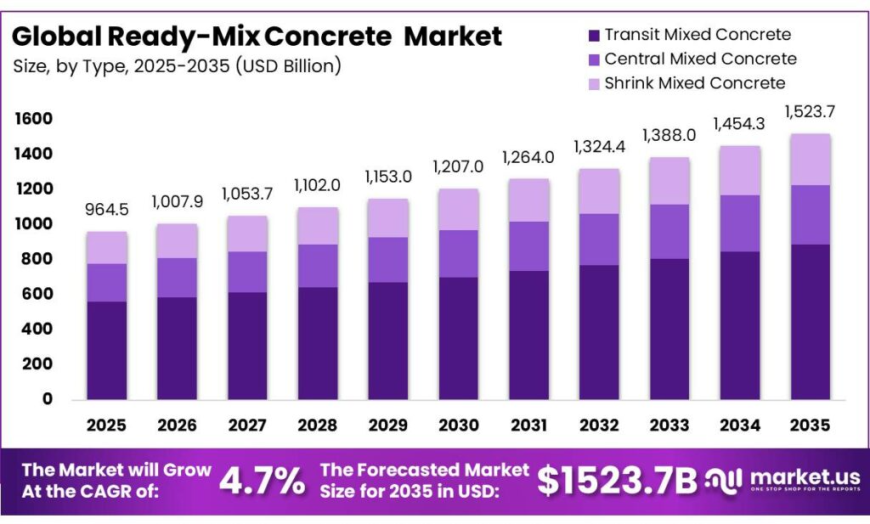
Ready-Mix Concrete Market is projected to grow from USD 964.5 billion in 2025 to approximately USD 1523.7 billion by 2035, registering a CAGR of 4.7% between 2026 and 2035. Asia Pacific held a dominant position with more than a 70.40% share, valued at USD 679.01 billion. The market outlook is influenced by infrastructure investment, urbanization, housing development, and advancements in sustainable concrete production.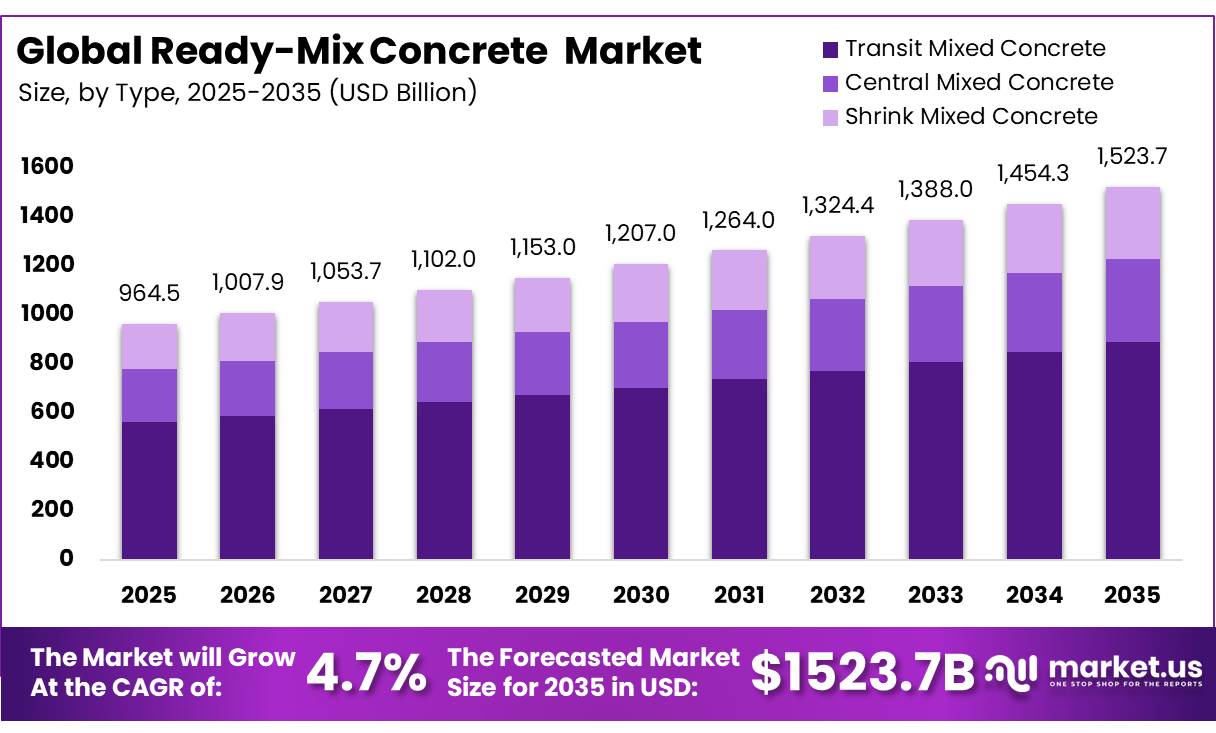
Key Takeaways
- The Global Ready-Mix Concrete Market was valued at USD 964.5 billion in 2025.
- The market is projected to grow at a CAGR of 4.7% and reach USD 1,523.7 billion by 2035.
- Transit Mixed Concrete dominated the market by type, accounting for 58.3% of the total market share.
- Residential applications led the market with a substantial share of 33.6%.
- Off-site Production dominated the production method segment, representing 63.0% of the total market.
- Barrel Truck/In-transit Mixers held a leading position among mixer types with a 73.0% market share.
- Asia Pacific was the dominant region in 2025, accounting for 70.4% of the total global market.
Type Analysis
Transit Mixed Concrete held the leading market position in 2025, capturing more than a 58.30% share. This segment remains preferred because concrete ingredients are mixed during transportation, allowing contractors to receive workable and uniform concrete at project locations. The method supports residential, commercial, and infrastructure projects where delivery timing, consistency, and placement efficiency are important. Transit mixed concrete also reduces the requirement for separate mixing equipment at construction sites and supports continuous concrete placement.
Central Mixed Concrete represents the fastest-growing segment due to improved quality control, accurate batching, and consistent mixing performance. The segment is gaining adoption in projects that require reliable strength, uniformity, and efficient production processes.
Application Analysis
Residential applications dominated the Ready-Mix Concrete Market in 2025, accounting for more than a 33.60% share. Demand from houses, apartments, renovation projects, and urban residential developments continues to support segment growth. Ready-mix concrete is widely used in foundations, floors, walls, driveways, and structural frames due to its consistent quality and faster placement capabilities.
Residential builders prefer centrally prepared concrete because it reduces on-site mixing requirements, improves material control, and supports construction schedules. Infrastructure remained the fastest-growing application segment, supported by increasing development of roads, bridges, tunnels, airports, rail systems, and public utilities requiring dependable concrete supply and uniform strength.
Production Method Analysis
Off-site Production dominated the market in 2025 with more than a 63.00% share. This method remains preferred because concrete is prepared in controlled batching plants before being transported to construction sites. It supports accurate measurement of materials, uniform mixing, quality assurance, and efficient site operations.
Contractors benefit from reduced on-site equipment requirements, lower material handling needs, and improved coordination across residential, commercial, and infrastructure projects. On-site Production continues to serve projects where flexible batching and immediate placement are necessary. It is useful for remote locations, specialized construction activities, and projects with changing volume requirements.
Mixer Type Analysis
Barrel Truck/In-transit Mixers held a dominant market position in 2025 with more than a 73.00% share. These mixers combine transportation with continuous drum rotation during delivery, helping maintain concrete consistency, limit early setting, and support timely placement across residential, commercial, industrial, and infrastructure sites.
Their broad availability, established operating process, and suitability for different delivery routes strengthen their importance in ready-mix operations. Volumetric Mixers are gaining attention for projects requiring flexible batch sizes and fresh mixing at the point of use. They support changing requirements, remote projects, small pours, and specialized applications.
Key Market Segments
By Type
- Transit Mixed Concrete
- Central Mixed Concrete
- Shrink Mixed Concrete
By Application
- Residential
- Infrastructure
- Commercial
- Industrial
By Production Method Type
- Off-site Production
- On-site Production
- By Mixer Type
- Barrel Truck/In-transit Mixers
- Volumetric Mixers
Driving Factors
Government-led infrastructure investment is a major growth driver for the Ready-Mix Concrete Market. Infrastructure renewal, public works, transportation projects, and urban development continue to create strong demand for concrete solutions.
Rapid urbanization and affordable housing demand are also supporting market expansion, particularly across Asia Pacific, emerging markets, and developing urban economies. The shift from on-site mixing toward ready-mix concrete improves consistency, labor efficiency, and construction speed. Additional growth opportunities are supported by green concrete adoption, low-carbon supplementary cementitious materials, digital batching, IoT-based delivery systems, and high-performance concrete admixtures. Future demand is expected to increase as construction industries focus on durable, efficient, and sustainable building solutions.
Restraining Factors
Raw material price volatility involving cement, aggregates, and energy costs creates pressure on production expenses and market profitability. The perishability of fresh concrete and transportation radius limitations also restrict operational flexibility because concrete must be delivered and placed within controlled time limits. Environmental compliance requirements create additional challenges for ready-mix producers.
Requirements related to Environmental Product Declarations (EPDs), lower Global Warming Potential (GWP) thresholds, and carbon reduction initiatives increase documentation and operational costs. High capital expenditure requirements, fragmented market structures, interest rate sensitivity, and regulatory differences across regions further influence market growth. Companies must invest in efficient production systems, logistics management, and sustainable technologies to remain competitive.
Growth Opportunity
Sub-Saharan Africa presents a significant opportunity for Ready-Mix Concrete Market expansion due to large-scale future construction requirements and increasing urban development. A major portion of Africa’s future building stock is yet to be constructed, creating opportunities for organized ready-mix concrete operators.
Countries including Nigeria, Ethiopia, Kenya, Ghana, and Côte d’Ivoire are experiencing strong urban population growth and increasing construction investment. The region also provides opportunities for low-carbon ready-mix solutions through the use of supplementary cementitious materials.
Companies entering these markets with efficient plant configurations, sustainable production methods, and localized supply chains may benefit from rising demand as construction activities expand across emerging urban economies.