Night Vision Compatibility and Optical Precision in Military Cockpit Displays
 nitsblogger
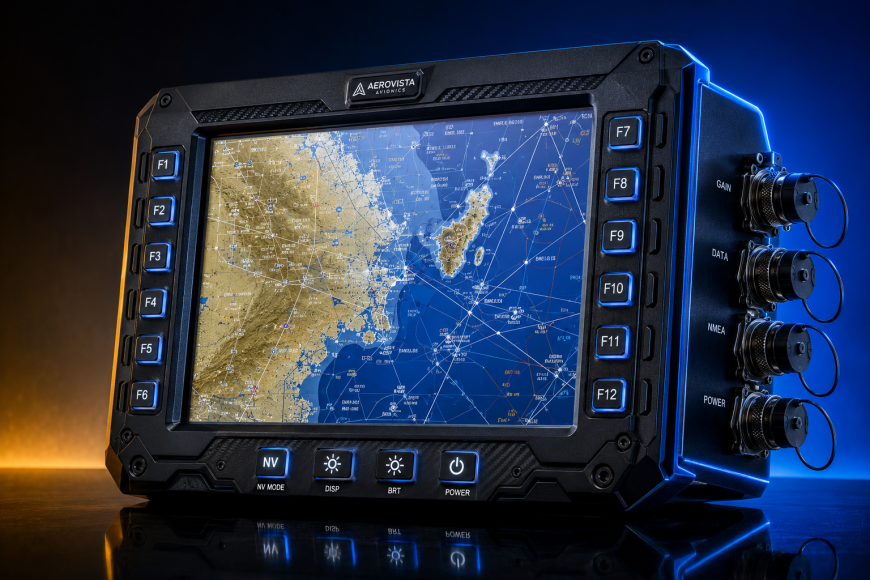
Night operations are where modern air forces expect to hold their advantage, and night vision goggles (NVGs) are the enabling technology. But NVGs amplify light thousands of times, and an ordinary cockpit display system radiates exactly the near-infrared energy that image intensifier tubes are most sensitive to. An unmodified display that looks comfortably dim to the naked eye can bloom a pilot's goggles into a wall of green glare. Making cockpit lighting invisible to the goggles while keeping it perfectly readable to the eye is one of the most exacting optical engineering challenges in avionics.
Why Standard Displays Blind the Goggles
Image intensifier tubes in Class B aviation goggles respond strongly to wavelengths from roughly 665 nanometers into the near infrared. LEDs, incandescent lamps, and LCD backlights all emit energy in this band even when their visible output is modest. When that energy reaches the goggle objective, the automatic gain control clamps down, washing out the outside scene. In practice, the pilot must choose between seeing the instruments and seeing the terrain, an unacceptable trade in low-level flight.
The Standards: MIL-STD-3009 and Its Heritage
Night vision imaging system (NVIS) compatibility is governed by MIL-STD-3009, the successor to MIL-L-85762A. The standard defines lighting classes, chromaticity limits for colors such as NVIS Green A, NVIS Green B, NVIS White, and NVIS Yellow, and, critically, maximum NVIS radiance values: the integrated energy a light source may emit within the goggle sensitivity band at a defined luminance. Compliance is verified with a calibrated spectroradiometer measuring the full spectral power distribution of every legend, annunciator, and display surface, not merely its visible brightness.
Engineering the Spectrum
Achieving compliance requires shaping light at the source. Manufacturers combine carefully binned LEDs with multilayer interference filters and absorptive dyes that cut off emissions sharply before the intensifier band, while preserving enough visible output for daylight readability. In NVIS-compatible panels and lighting, the filter stack, diffusers, and light guides are engineered together so that chromaticity stays within the specified boundaries across the entire dimming range, typically spanning several orders of magnitude from full daylight luminance down to adjusted night settings.
The Daylight Readability Paradox
The same instrument that must be nearly invisible to goggles at night must remain legible against 10,000 foot-lambert sunlight the next morning. Resolving this paradox requires enormous dimming ratios, carefully designed anti-reflective surfaces, and drive electronics that control luminance smoothly at the very bottom of the range, where cheap dimming schemes flicker or shift color. Getting this transition right is what allows a single cockpit to serve a dawn takeoff, a midday transit, and a blacked-out night approach without the crew ever fighting their own instruments.
Optical Precision Beyond the Spectrum
NVIS compliance alone does not make a display flyable. Luminance uniformity across the panel face, matched brightness between adjacent instruments, minimal reflectance from cover glass, and stable color at every dimmer position all determine whether a cockpit is usable through a whole night sortie. Because LED output and filter behavior shift with temperature, thermal design and electronic compensation are part of the optical solution. The result must be verified unit by unit, since small variations in filter thickness or LED bins can push radiance out of limits.
A Trusted Partner for NVIS Lighting
Aeromaoz is a world-known supplier of rugged, mission-critical HMI solutions and has specialized in NVIS-compatible illuminated panels, bezels, displays, and cockpit lighting for more than 45 years. Serving military and commercial aviation, armored vehicles, UAVs, flight simulators, and naval platforms, the company delivers systems with advanced internal light balancing that meet stringent quality and certification requirements for Tier 1 integrators worldwide.
As sensors and goggles keep improving, radiance budgets only get tighter. Programs that treat NVIS as a precision optical discipline, backed by spectroradiometric verification and decades of lighting expertise, are the ones whose crews truly own the night.