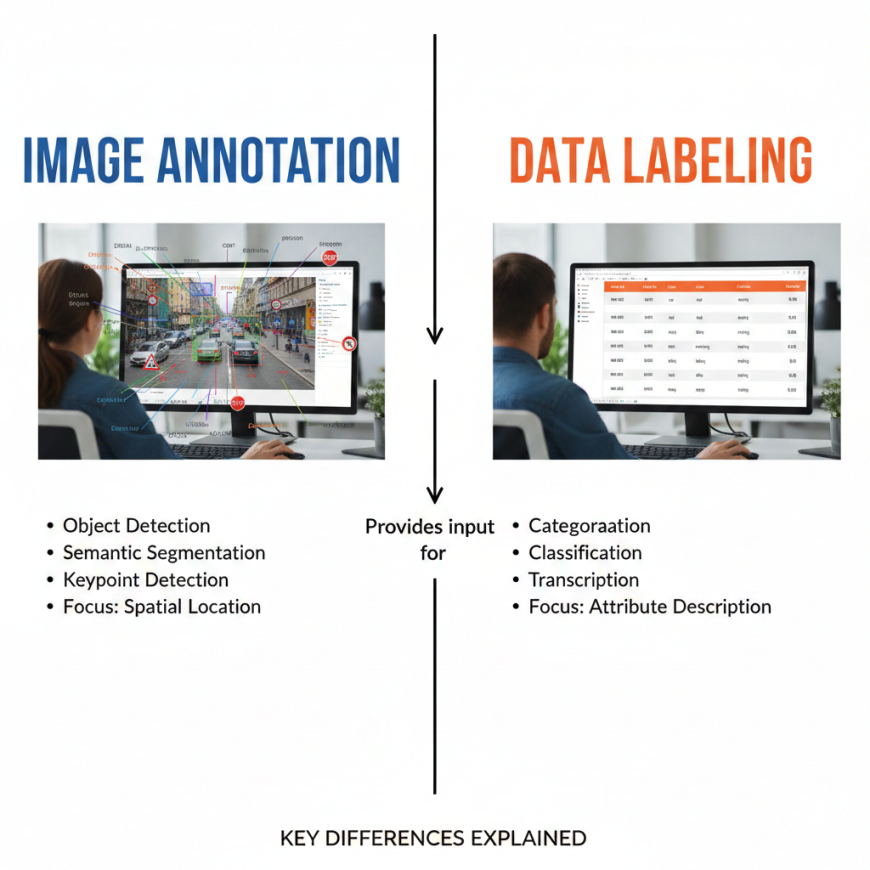
In the rapidly evolving AI ecosystem, terms like image annotation and data labeling are often used interchangeably. However, for organizations building high-performance machine learning (ML) models, the distinction is not just semantic—it directly impacts model accuracy, scalability, and cost efficiency.
At Annotera, a leading data annotation company, we help enterprises navigate these nuances to build robust datasets through precision-driven workflows and scalable image annotation outsourcing solutions. This article breaks down the key differences between image annotation and data labeling, their applications, and how to choose the right approach.
Understanding Data Labeling
Data labeling is the foundational step in preparing datasets for supervised learning. It involves assigning predefined tags or categories to raw data such as images, text, or videos.
For example:
-
Tagging an image as “car” or “pedestrian”
-
Labeling an email as “spam” or “not spam”
-
Assigning sentiment labels like “positive” or “negative”
The primary objective of data labeling is categorization. It enables machine learning models to recognize patterns and make predictions based on labeled examples.
Key Characteristics of Data Labeling
-
Simple classification tasks
-
Low complexity and high scalability
-
Suitable for large datasets
-
Often handled by general annotators
Data labeling is widely used in early-stage AI projects or when the requirement is straightforward classification, such as image classification or sentiment analysis.
Understanding Image Annotation
Image annotation is a more advanced and specialized subset of data annotation focused specifically on visual data. It goes beyond assigning labels by adding detailed metadata to different elements within an image.
This includes:
-
Bounding boxes around objects
-
Semantic segmentation (pixel-level labeling)
-
Keypoint annotation (e.g., facial landmarks)
-
Object tracking across frames
Unlike simple labeling, annotation provides spatial and contextual information that helps models understand not just what is in the image, but where and how objects relate to each other.
Key Characteristics of Image Annotation
-
High granularity and precision
-
Spatial and contextual enrichment
-
Requires skilled annotators or domain experts
-
Used in complex computer vision tasks
As an experienced image annotation company, Annotera leverages advanced tools and human-in-the-loop pipelines to ensure high-quality annotations for complex use cases.
Core Differences Between Image Annotation and Data Labeling
While both processes contribute to training AI models, their scope and depth differ significantly.
1. Scope and Definition
Data labeling is a narrower process focused on assigning categories to entire data points. Image annotation, on the other hand, is broader and includes labeling plus additional contextual and spatial information.
2. Level of Detail
Labeling answers: “What is this?”
Annotation answers: “What is this, where is it, and how does it relate to other elements?”
Annotation enriches datasets with deeper insights, enabling more sophisticated model behavior.
3. Complexity
Data labeling is relatively simple and scalable, making it ideal for high-volume tasks. Image annotation involves intricate processes such as segmentation and object detection, increasing both complexity and cost.
4. Output Format
-
Data Labeling: Simple tags (CSV, JSON)
-
Image Annotation: Structured formats like COCO, YOLO, or Pascal VOC with coordinates and metadata
5. Use Cases
-
Data Labeling: Image classification, sentiment analysis, spam detection
-
Image Annotation: Autonomous driving, medical imaging, retail analytics, surveillance
Practical Example: Labeling vs Annotation in Computer Vision
To illustrate the difference, consider a dataset of street images:
-
Data Labeling:
Each image is tagged as “urban street” or “highway.”
-
Image Annotation:
The same image includes bounding boxes for cars, pedestrians, traffic lights, and lane markings, along with their positions and relationships.
This distinction is crucial because advanced computer vision systems rely on detailed annotations to perform tasks like object detection and segmentation.
When to Use Data Labeling vs Image Annotation
Choosing between the two depends on your project requirements, model complexity, and business objectives.
Use Data Labeling When:
-
You need quick categorization of large datasets
-
The problem involves simple classification
-
Budget and turnaround time are key constraints
Use Image Annotation When:
-
Your model requires spatial awareness (e.g., object detection)
-
Precision is critical (e.g., healthcare, autonomous vehicles)
-
You need contextual understanding within images
In many real-world scenarios, both approaches are used together—labeling for initial categorization and annotation for deeper insights.
Role of Data Annotation Companies
Partnering with a professional data annotation company ensures quality, consistency, and scalability across your datasets.
At Annotera, we specialize in:
-
End-to-end data annotation outsourcing
-
High-quality image annotation outsourcing workflows
-
Multi-layer quality assurance pipelines
-
Domain-specific annotation expertise
Outsourcing annotation tasks allows businesses to focus on model development while ensuring datasets meet enterprise-grade standards.
Challenges in Image Annotation and Data Labeling
Despite their importance, both processes come with challenges:
1. Quality Control
Inconsistent labeling or annotation can significantly impact model performance. High-quality datasets are essential for accurate predictions.
2. Scalability
While labeling scales easily, annotation requires more resources and expertise, making it harder to scale without the right infrastructure.
3. Cost Considerations
Annotation is more resource-intensive, especially for tasks like segmentation or 3D annotation.
4. Human Dependency
Both processes rely heavily on human input, which introduces variability. Human-in-the-loop systems are often used to mitigate errors.
Future Trends in Annotation and Labeling
The industry is moving toward more intelligent and automated solutions, including:
-
AI-assisted annotation tools
-
Active learning to reduce labeling effort
-
Synthetic data generation
-
Hybrid human-AI workflows
As AI models become more sophisticated, the demand for detailed annotation over simple labeling continues to grow.
Conclusion
While data labeling and image annotation are closely related, they serve distinct roles in the AI pipeline. Data labeling provides the foundational categorization needed for basic model training, whereas image annotation delivers the depth and context required for advanced computer vision applications.
For organizations aiming to build high-performance AI systems, understanding this distinction is critical. By partnering with an experienced image annotation company like Annotera, businesses can leverage scalable data annotation outsourcing and image annotation outsourcing solutions to accelerate model development while maintaining accuracy and consistency.
Ultimately, the choice is not about labeling versus annotation—it’s about selecting the right combination to meet your AI objectives efficiently.

 annotera