How Can AWS CloudFront Reduce Latency for Global Applications?
 kirtikasharma
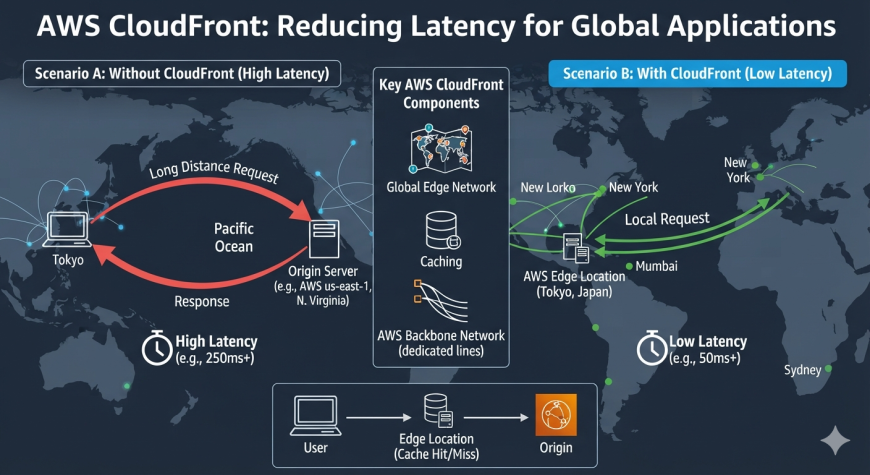
Users of modern apps are in different geo regions. Speed and reliability of information distribution matter a lot. If the content is served from a single central server, users distant from the server will experience increased latency or slower loading times. That's where Amazon CloudFront comes in. It is a global content delivery network (CDN) that provides content to the users faster. AWS Training is the greatest investment for professionals who wish to build cloud computing skills. Amazon CloudFront enhances application speed, scalability, and user experience. In this article, we’ll discuss its characteristics and how it might help minimize latency for worldwide applications.
Understanding the Amazon CloudFront
A global content delivery network (CDN) like Amazon CloudFront stores web content like HTML pages, CSS files, JavaScript, pictures, and videos in many edge locations around the world to make delivery faster.
Challenges Solved by Features of AWS CloudFront
|
Challenges |
Features |
Solution |
|
High latency for worldwide users |
Global Edge Network |
It keeps static assets at edge locations close to the end consumers. |
|
Heavy Origin Server Load |
Regional Cache & Edge |
Processes requests directly from local caches instead of main databases. |
|
Slow Delivery of Dynamic Content |
Optimized Routing of Network |
Uses AWS’s high-speed, private backbone network to route traffic. |
|
DDoS Threats & Cyber Attacks |
Integration with AWS Shield and WAF |
Blocks harmful web traffic. Soaks up DDoS attacks at the network edge. |
|
Large File (Uncompressed) |
Automatic Gzip & Brotli Compression |
It compresses web files before transmitting them to save download times. |
Learn these important features by enrolling in an AWS Course in Pune. This course helps you in updating your application development skills.
How Amazon CloudFront Cuts Down on Latency
Amazon CloudFront gives you a number of ways to cut down on latency:
1. Select Edge Places
CloudFront caches content at the edge locations around the world. Content is served to users from the closest server.
2. Route Traffic Over the AWS Private Network
Requests are made over AWS’s private global network of fiber-optic cables, avoiding the slow, congested public Internet. This private network uses the best routing paths, avoiding Internet bottlenecks.
3. SSL Termination and Persistent Connections at the Edge
New SSL/TLS security handshakes for long-distance connections increase initial page load latency. CloudFront terminates SSL connections at the edge server closest to the user. It keeps the links to the original server open, which saves the important setup time.
4. Smart Content Acceleration for Static and Moving Content
CloudFront is not only about speeding up static content such as photos or CSS files. It modifies the TCP parameters and keeps open connection channels to send dynamic content such as real-time live feeds or API answers.
5. Automatic Edge Payload Compression
CloudFront automatically compresses your text files, CSS scripts, and JavaScript files using the Gzip or Brotli algorithms before it distributes them. Smaller payloads mean files are delivered faster and pages are generally rendered faster.
6. Edge Serverless Computing for Running Code
CloudFront Functions and Lambda@Edge allow developers to execute lightweight code at the edge locations. You can rewrite URLs, handle authentication, and customize replies locally without querying the main backend server.
Understand the AWS CloudFront practical by enrolling in the best AWS training and become an AWS certified AI Practitioner.
The bottom line
Modern applications need fast digital experiences to be delivered to global audiences. AWS CloudFront reduces global latency problems by caching material close to consumers, compressing web files, and taking advantage of AWS’s private global network. CloudFront offloads traffic from servers and optimizes network paths so that organizations can deliver digital applications anywhere in the world at lightning speed.