What is the global K-12 education technology market size?
The global K-12 education technology market was valued at USD 126.9 billion in 2025 and is projected to reach USD 491.5 billion by 2035. The market is expected to grow at a CAGR of 14.5% from 2025 to 2035. Growth is being supported by rising digital classroom adoption, remote and hybrid learning models, online assessments, AI-based learning tools, and government investment in school technology.
 globemarketresearch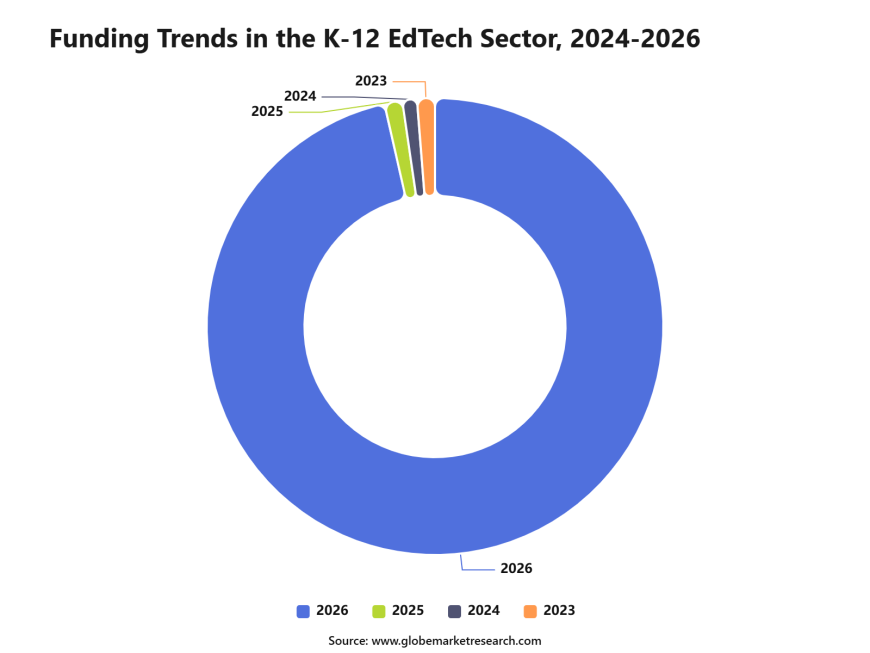
Software held 42.6% share in the K-12 Education Technology Market, supported by the growing use of digital learning platforms, online assessment tools, e-learning content, classroom management software, and student performance tracking systems. Schools are increasingly adopting software-based tools to improve lesson delivery, reduce manual work, and support better communication between teachers, students, and parents.
The growth of the software segment can also be attributed to the wider use of personalized learning tools and digital content libraries. As schools continue to shift from traditional teaching aids to structured digital platforms, software is becoming a core part of daily academic operations across public and private K-12 institutions.
By Deployment
Cloud deployment accounted for 71.3% share, driven by easier access, faster updates, lower infrastructure requirements, and stronger support for remote and hybrid learning. Cloud-based systems allow schools to manage learning content, student data, assignments, assessments, and communication tools without heavy investment in on-premise servers.
The segment is also supported by the need for flexible education delivery across classrooms, homes, and mobile devices. Cloud platforms help school districts scale digital learning programs more efficiently while enabling teachers and students to access learning tools from different locations.
By Platform
Learning Management Systems held 31.4% share, supported by their strong role in course delivery, assignment management, student progress tracking, attendance monitoring, and teacher-student communication. These systems help schools organize academic activities in one place and improve the visibility of student performance.
The demand for Learning Management Systems is rising as schools focus on structured digital learning workflows. Teachers use these platforms to upload lessons, assign tasks, conduct tests, share feedback, and track learning outcomes, which makes them highly useful for both classroom-based and blended education models.
By Learning Mode
Classroom learning captured 39.6% share, supported by the rising use of smart classrooms, interactive displays, digital boards, connected devices, and multimedia-based teaching tools. Schools are using technology to make classroom sessions more engaging, visual, and easier to understand for students.
The growth of classroom learning is also linked to the continued importance of in-person teaching in K-12 education. Digital tools are being used to support teachers rather than replace classroom instruction, which helps improve participation, content delivery, and real-time student engagement.
By End User
Public K-12 schools represented 53.8% share, supported by large student enrollment, government education funding, public digital learning programs, and wider adoption of technology across school districts. Public schools remain the largest user base because they serve a broad student population and require scalable education solutions.
The segment is further supported by investments in digital classrooms, online learning access, student data systems, and teacher training programs. As governments and school authorities continue to modernize public education, technology adoption in public K-12 schools is expected to remain strong.
By Region
North America held 39.9% share, supported by strong school technology spending, high internet access, advanced digital infrastructure, and early adoption of education technology platforms. The region has a mature digital education ecosystem, with schools actively using learning platforms, digital content, student analytics, and connected classroom tools.
The regional leadership is also supported by the presence of well-funded school districts and strong demand for personalized learning. North America continues to adopt education technology to improve academic outcomes, support hybrid learning, and strengthen classroom productivity.
U.S. Market
The U.S. K-12 education technology market was valued at USD 98.5 billion and is projected to grow at a CAGR of 13.1%. Growth is supported by continued investment in smart classrooms, digital textbooks, student analytics, adaptive learning tools, and cloud-based education platforms.
The U.S. market benefits from strong technology infrastructure, high digital learning adoption, and active use of online education tools across schools. Rising demand for personalized learning, data-driven student support, and efficient classroom management is expected to keep the country at the center of K-12 education technology adoption.
Latest Driver Analysis: Rising Use of AI to Reduce Teacher Workload
The latest driver for the K-12 Education Technology market is the fast adoption of AI tools by teachers for lesson planning, worksheet creation, content modification, and administrative support. In the 2024-25 school year, Gallup reported that 60% of U.S. public school teachers used AI tools, while 32% used them at least weekly. This shows that AI is moving from trial use to routine classroom and back-office support, especially where teachers face time pressure and high workload.
This trend is important because schools are no longer buying digital tools only for online learning. They are looking for platforms that save teacher time, improve content quality, and support differentiated learning for students with different needs. AI-enabled lesson support, assessment assistance, and adaptive content are expected to gain stronger attention from districts that need measurable classroom value. Gallup and the Walton Family Foundation also found that teachers using AI saved about 5.9 hours per week, which strengthens the productivity case for AI-based EdTech tools.
Latest Restraint Analysis: Post-ESSER Budget Pressure
A key restraint for the K-12 EdTech market is tighter school spending after the end of emergency pandemic relief funds. The ESSER program provided nearly USD 190 billion in federal K-12 support, and by early 2025 districts had largely spent the final funds. This is creating a more cautious purchasing environment, where district leaders are reviewing which platforms are essential and which tools can be reduced or removed.
This restraint is expected to affect renewals, upgrades, and multi-year software contracts. Schools are now asking for stronger proof of learning outcomes, clear usage data, and lower total cost of ownership before approving new EdTech purchases. Vendors that cannot show measurable impact may face slower sales cycles, especially in districts dealing with inflation, enrollment decline, and recurring technology replacement costs. Recent education technology coverage also shows that the end of ESSER funding is forcing schools to reassess the value of existing digital tools.
Latest Opportunity Analysis: Digital Inclusion and AI-Ready Learning Infrastructure
A major opportunity is the continued push to improve school connectivity, digital infrastructure, and AI-ready learning systems. UNICEF’s Digital Education Strategy 2025-2030 states that 1.3 billion children, around two-thirds of the world’s school-age population, still lack internet access at home. This gap creates a large need for affordable learning platforms, offline-first content, school connectivity solutions, device access, and teacher digital training.
The opportunity is also supported by public investment priorities in digital education. The World Bank stated that, as of 2025, more than 94% of its education projects included an EdTech component, covering school digital infrastructure, learning platforms, and digital skills for teachers and students. This signals that EdTech demand is not limited to high-income markets, as governments and development agencies are using technology to improve access, learning continuity, and system resilience.
Latest Challenge Analysis: Cybersecurity, Privacy, and AI Governance Gaps
The main challenge for the K-12 EdTech market is rising concern around student data protection, cybersecurity, and responsible AI use. RAND reported in 2025 that 60% of K-12 principals said their schools had experienced at least one cybersecurity incident during the 2023-24 and 2024-25 school years. This increases pressure on districts to choose vendors with strong data security, access controls, privacy safeguards, and incident response processes.
AI governance is also becoming a serious implementation challenge. RAND found that, as of spring 2025, only 35% of district leaders reported providing students with AI training, while more than 80% of students said teachers had not explicitly taught them how to use AI for schoolwork. This gap can slow adoption because parents, teachers, and administrators need clearer rules on academic integrity, child safety, bias, and appropriate classroom use before AI-based tools can scale responsibly.
Explore More Reports