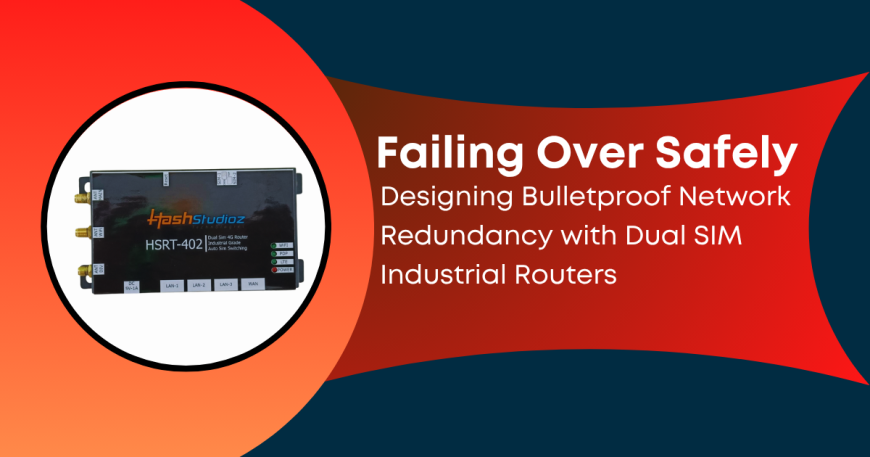
Failing Over Safely: Designing Bulletproof Network Redundancy with Dual SIM Industrial Routers
 JamesHunt
Modern industrial automation relies entirely on continuous data flow. In automated factories, energy grids, oil rigs, and remote water treatment plants, a network outage causes immediate financial loss. According to industry research, a single hour of downtime costs ninety-eight percent of large enterprises over $100,000. For critical industrial sectors, that number often exceeds $300,000 per hour.
Wireline connections like fiber or copper can fail at any time. Construction crews cut underground cables during excavation. Extreme weather damages physical infrastructure over large geographic areas. To prevent these costly interruptions, engineers deploy wireless backups. An Industrial Router equipped with cellular capabilities offers a robust solution for edge infrastructure.
However, relying on a single cellular carrier introduces a single point of failure. Cell towers lose power, experience software glitches, or face localized network congestion. True network resilience requires multiple cellular pathways. Engineers achieve this by using a Dual Sim Industrial Router to design bulletproof failover systems.
Understanding Dual SIM Architectures
A Dual Sim Industrial Router contains physical slots for two distinct subscriber identity module (SIM) cards. These SIM cards should connect to two separate cellular network providers. If Carrier A loses its signal, the router switches to Carrier B. Industrial routers handle these two SIM cards using two primary architectural designs.
1. Single-Radio Dual SIM
The single-radio router contains two SIM slots but only one cellular modem. Only one SIM card connects to a network at any given moment. This design limits the capabilities of the backup link. The router must disconnect from the first network before connecting to the second. This process takes time. The modem must detach, switch SIM profiles, register on the new network, and obtain an IP address. This switchover delay takes anywhere from thirty seconds to three minutes. This interruption disrupts real-time industrial applications.
2. Dual-Radio Dual SIM
The dual-radio router contains two separate modems and two SIM slots. Both SIM cards remain active simultaneously. The device maintains concurrent active connections to both carriers. It routes traffic across both paths in real time. If one path fails, the other path immediately absorbs the traffic. This process occurs in milliseconds. It provides an instantaneous failover that protects critical applications from packet loss.
Mechanics of Failover Verification
Simple failover systems only check for a cellular signal. If the modem detects an RF signal from a tower, the router assumes the connection works. This assumption is dangerous. A router can connect to a cell tower while internet access remains broken. This state is called dead-end connectivity. The cellular link is up, but data cannot reach its destination. Robust industrial routing requires active link monitoring to test the actual data path.
1. ICMP Ping Detection
The router sends periodic Internet Control Message Protocol (ICMP) echo requests to known public IP addresses. Common targets include public DNS servers or internal corporate gateways. Engineers configure specific parameters for these tests:
-
Ping Interval: How often the router sends a packet, such as every five seconds.
-
Retry Count: How many failed pings indicate a dead link, such as three consecutive failures.
-
Timeout: How long the router waits for a response, such as two seconds.
Using these settings, the router detects a failure within fifteen seconds. It then initiates the failover process to the secondary carrier.
2. HTTP and DNS Probing
Some cellular carriers optimize ICMP traffic or block it entirely during congestion. In these cases, ICMP pings give false failure readings. Advanced routers use HTTP GET requests or DNS queries instead. The router requests a small webpage or resolves a specific domain name. If the request succeeds, the link is truly operational. This method eliminates false positives caused by carrier-side ICMP filtering.
Designing Failover Policies
Engineers must choose how the router handles the two network connections. The choice depends on data budgets, bandwidth needs, and application priorities.
1. Active-Passive Mode
In active-passive mode, the router uses the primary SIM for all data traffic. The secondary SIM remains idle. The router only activates the secondary SIM when the primary link fails completely. This setup suits scenarios where the backup carrier charges high data rates or has a limited data cap. It keeps operational costs low while providing a safety net.
2. Active-Active Load Balancing
In active-active mode, the router utilizes both cellular networks at the same time. The device splits traffic between the two modems based on pre-defined policies. Engineers can balance traffic by weight. For example, the router sends seventy percent of data through Carrier A and thirty percent through Carrier B. This mechanism maximizes available bandwidth for field operations. If one carrier fails, the router shifts all traffic to the remaining operational link without dropping current sessions.
3. Least-Cost Routing
Industrial deployments often mix different types of data plans. The primary SIM might offer unlimited data, while the backup SIM charges per megabyte. Least-cost routing configurations force the router to prefer the cheapest connection under normal circumstances. It only uses the expensive cellular network for critical telemetry data during an emergency. The system drops non-essential traffic like video feeds until the primary link recovers.
Security for Redundant Networks
A failover event shifts industrial data to a different public network infrastructure. Engineers must maintain consistent security policies across both pathways to protect corporate assets.
1. IPSec and OpenVPN Tunnels
Industrial devices must communicate over encrypted Virtual Private Network (VPN) tunnels. When a failover occurs, the router must re-establish these tunnels over the secondary network instantly. Dual-radio routers maintain two distinct VPN tunnels simultaneously. If the primary connection drops, the router switches traffic into the backup tunnel. The internal industrial devices notice no security disruption or downtime.
2. Private Access Point Names
Securing the cellular connection itself requires Private Access Point Names (APNs). A private APN isolates the industrial devices from the public internet entirely. Carriers assign static private IP addresses to the SIM cards. The router only accepts incoming connections from authorized corporate gateways. This setup prevents unauthorized scans and cyber attacks from hitting the industrial edge.
Real-World Edge Deployment Examples
Looking at specific industrial deployments highlights the necessity of advanced failover engineering in the field.
1. Remote Oil and Gas Wellheads
Oil wellheads operate in remote locations with poor cellular coverage. Weather changes alter signal propagation constantly. An operator installs an industrial cell router at a wellhead site. SIM one connects to a low-frequency LTE network that offers long range but low bandwidth. SIM two connects to a high-frequency network with high bandwidth but poorer terrain penetration.
During clear weather, the router transmits high-definition surveillance video over the high-frequency network. During heavy rain, the high-frequency signal degrades significantly. The router detects packet loss immediately. It shifts critical SCADA telemetry data to the stable low-frequency network. This action drops the video feed but keeps the control connection alive.
2. Electrical Substation Automation
Electrical grids require millisecond-level precision for protection relays. A network delay can cause widespread power outages. Engineers deploy dual-radio industrial routers in substations to mitigate this risk. The router connects to two different infrastructure providers simultaneously.
The router duplicates critical grid messages. It sends one copy over Carrier A and an identical copy over Carrier B. The receiving control center accepts the packet that arrives first and discards the duplicate. If one carrier network fails completely, zero packets are lost. The grid remains stable.
Key Hardware Considerations
Not all routers can survive industrial environments. Commercial office routers will fail quickly in these harsh settings due to thermal and mechanical stress.
1. Thermal and Mechanical Resilience
Industrial environments experience extreme temperatures and heavy vibrations. A proper industrial cellular device features an aluminum or steel enclosure without moving fans. The device must operate across a wide temperature range, typically from minus forty degrees to plus seventy-five degrees Celsius. The internal components must withstand constant vibration from nearby pumps, motors, and heavy machinery.
2. Electrical Isolation
Industrial plants suffer from voltage spikes and electromagnetic interference (EMI). Routers require isolated power inputs and isolated communication ports. Galvanic isolation protects the router's internal circuits from ground loops. It also prevents high-voltage surges on serial or Ethernet cables from destroying the cellular modem components.
Best Practices for Configuration
Building a reliable failover system requires careful software configuration. Engineers must avoid default settings to achieve true network resilience.
1. Set Realistic Hold-Down Timers
When a failed network comes back online, it can be highly unstable. This condition causes network flapping, where the router rapidly switches between carriers. Flapping destroys network performance and corrupts data packets. Engineers must implement a hold-down timer. This setting forces the router to stay on the backup connection for a set period, such as ten minutes, after the primary link recovers. This delay ensures the primary network is completely stable before switching traffic back to it.
2. Diversify Carrier Infrastructure
A dual SIM system only provides redundancy if the carriers use separate physical infrastructure. Many smaller mobile virtual network operators lease tower space from major carriers. If you buy two SIM cards that utilize the same physical towers, you have no real redundancy during a tower outage. Engineers must verify the underlying infrastructure of their chosen providers. Select carriers that own separate tower networks and distinct fiber backhaul routes.
Conclusion
Designing bulletproof network redundancy requires specialized hardware and intelligent software configuration. A Dual Sim Industrial Router provides the essential foundation for this high-availability architecture. By selecting dual-radio systems, implementing active network probing, and enforcing strict security protocols, engineers protect industrial operations from costly communication failures. High-availability networking keeps automated systems online when physical infrastructure fails, preserving profitability and operational safety.