Everything You Need to Know About BIS Scheme X Certification
Learn about BIS Scheme X Certification, its process, documentation, and compliance requirements. Understand BIS Scheme X QCO and how a scheme X consultant can help manufacturers obtain certification smoothly in India.
 prolixindia
Introduction
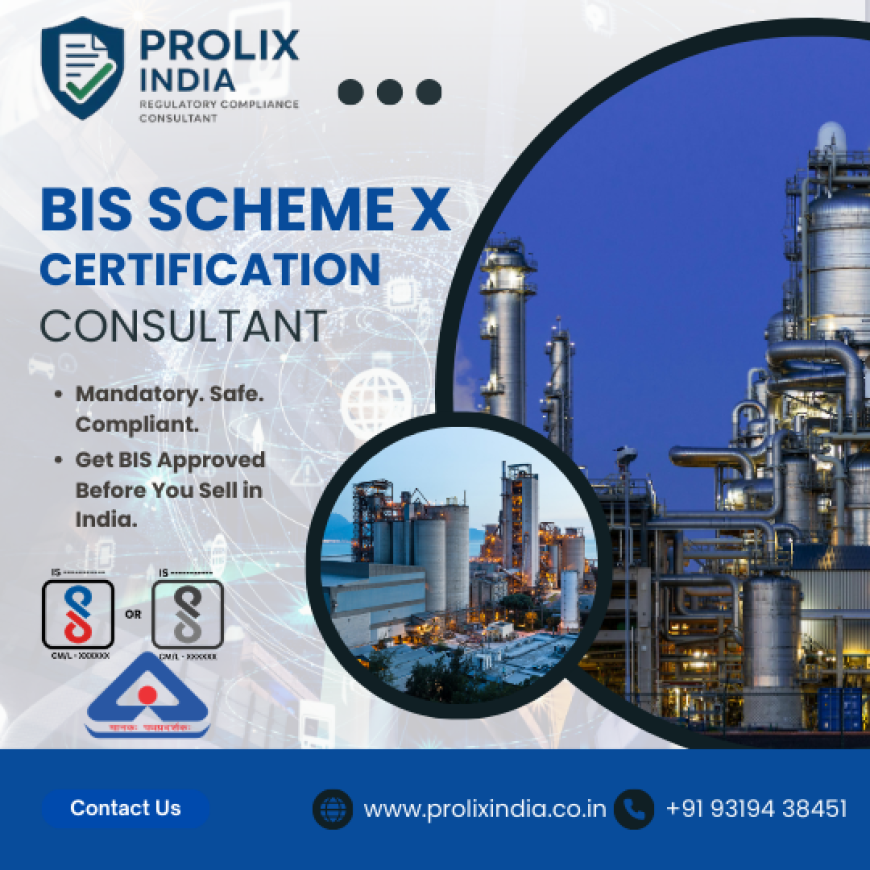
India has established several regulatory frameworks to ensure that products entering the market meet strict safety and quality standards. One such important compliance framework is BIS Scheme X, introduced by the Bureau of Indian Standards (BIS). This scheme focuses on ensuring that specific industrial products comply with mandatory quality requirements before they are manufactured, imported, or sold in India.
With increasing government emphasis on product safety, the demand for BIS Scheme X Certification has grown significantly. Manufacturers, importers, and businesses dealing with regulated products must understand the scope, compliance process, and regulatory requirements associated with this scheme.
This article explains the concept of Scheme X, its purpose, certification process, and the role of a scheme x consultant in helping businesses achieve compliance efficiently.
Understanding BIS Scheme X
BIS Scheme X is a certification framework introduced by the Bureau of Indian Standards under the BIS Conformity Assessment Regulations. The scheme primarily focuses on ensuring that certain categories of products comply with Indian Standards before they are placed in the Indian market.
Under this scheme, manufacturers must obtain certification from BIS to confirm that their products meet the prescribed quality, safety, and performance standards. Once certified, manufacturers are permitted to use the BIS Standard Mark on their products.
The objective of this scheme is to maintain consistent product quality, protect consumers, and ensure that manufacturers follow standardized production processes.
What is BIS Scheme X Certification?
BIS Scheme X Certification is the approval granted by the Bureau of Indian Standards after verifying that a manufacturer’s product meets the applicable Indian Standard and regulatory requirements.
The certification process involves multiple steps including application submission, document verification, product testing, factory inspection, and compliance assessment. Only after successfully completing these steps does BIS grant the certification.
Once approved, the manufacturer can legally manufacture, import, distribute, or sell the certified product in India.
Importance of BIS Scheme X
BIS certification under Scheme X plays a crucial role in maintaining quality control in the Indian market. It benefits both manufacturers and consumers in several ways.
1. Ensures Product Quality
The scheme ensures that products meet predefined Indian Standards, maintaining a consistent level of safety and reliability.
2. Consumer Protection
Products certified under the scheme provide assurance to consumers regarding quality and safety.
3. Legal Market Entry
Many products covered under BIS Scheme X QCO require mandatory certification before they can be sold in India.
4. Strengthens Brand Credibility
Certified manufacturers gain trust and credibility in the marketplace.
BIS Scheme X QCO (Quality Control Orders)
A Quality Control Order (QCO) is issued by the Government of India to make certification mandatory for specific products. When a product is covered under a BIS Scheme X QCO, manufacturers must obtain BIS certification before entering the Indian market.
These orders are typically introduced for products that have significant safety, environmental, or performance implications. The government issues such regulations to eliminate substandard products from the market.
Manufacturers who fail to comply with these orders may face penalties, product recalls, or restrictions on product sales.
Products Covered Under Scheme X
The scope of Scheme X typically includes industrial materials and critical components that require strict quality monitoring. These products often include:
-
Industrial raw materials
-
Metal and alloy products
-
Construction materials
-
Chemical products
-
Safety-critical industrial equipment
The exact product list may vary depending on the Quality Control Orders issued by the government from time to time.
BIS Scheme X Certification Process
Obtaining certification under Scheme X involves several regulatory steps. The process is designed to verify that both the product and the manufacturing facility comply with BIS standards.
Step 1: Application Submission
The manufacturer submits an application to BIS along with product details, manufacturing information, and required documentation.
Step 2: Document Verification
BIS reviews all submitted documents to ensure compliance with regulatory requirements.
Step 3: Product Testing
Samples of the product are tested in BIS-recognized laboratories to verify compliance with the relevant Indian Standard.
Step 4: Factory Inspection
BIS officials conduct a factory audit to assess the manufacturing process, quality control system, and production capability.
Step 5: Grant of Certification
If the product and manufacturing facility meet all requirements, BIS grants the certification and authorizes the use of the BIS Standard Mark.
Documents Required for BIS Scheme X Certification
The certification process requires several documents to verify product quality and manufacturing capability. Some commonly required documents include:
-
Company registration documents
-
Manufacturing unit details
-
Product specifications and technical drawings
-
Quality control procedures
-
Test reports from recognized laboratories
-
Factory layout and production flow chart
-
Authorized signatory details
Accurate documentation plays a key role in ensuring smooth approval during the certification process.
Role of a Scheme X Consultant
The certification process can be complex due to regulatory procedures, documentation requirements, and technical testing standards. This is where a scheme x consultant can assist manufacturers in managing the entire compliance process.
A consultant helps businesses understand regulatory requirements, prepare documentation, coordinate product testing, and manage communication with BIS authorities.
Working with a top scheme x consultant can help manufacturers reduce delays, avoid application errors, and ensure that the certification process moves smoothly.
Consultants also provide guidance on regulatory updates, product standard changes, and ongoing compliance requirements after certification.
Compliance and Post-Certification Requirements
After receiving certification, manufacturers must continue to comply with BIS standards. BIS may conduct periodic inspections and surveillance audits to ensure that the manufacturing process continues to meet quality requirements.
Manufacturers must also maintain proper testing records, quality control documentation, and product traceability systems. Non-compliance can lead to suspension or cancellation of certification.
Therefore, maintaining a strong quality management system is essential for long-term compliance.
Conclusion
Prolix India is one of the leading BIS Consultant in India , helping manufacturers obtain their BIS licences hassle-free.BIS Scheme X plays an important role in strengthening product quality standards across multiple industries in India. Through mandatory certification, strict testing, and factory inspections, the scheme ensures that only compliant products reach the market.
Manufacturers must carefully follow the BIS Scheme X Certification process and comply with applicable BIS Scheme X QCO regulations to avoid legal complications and market restrictions.
Since the certification process involves multiple technical and regulatory steps, many businesses prefer working with experienced professionals. A knowledgeable consultant can help companies navigate compliance requirements efficiently and achieve certification with minimal delays.