Energy-Dispersive vs Wavelength-Dispersive XRF: Choosing the Right Method
Learn Energy vs Wavelength Dispersive XRF differences, benefits, and applications to choose the right XRF method for accurate elemental analysis.
 labatoz
In modern laboratories and industrial quality control environments, elemental analysis plays a critical role in ensuring product consistency, regulatory compliance, and research accuracy. Among the most trusted analytical techniques is X-ray fluorescence (XRF), a non-destructive method used to determine the elemental composition of materials.
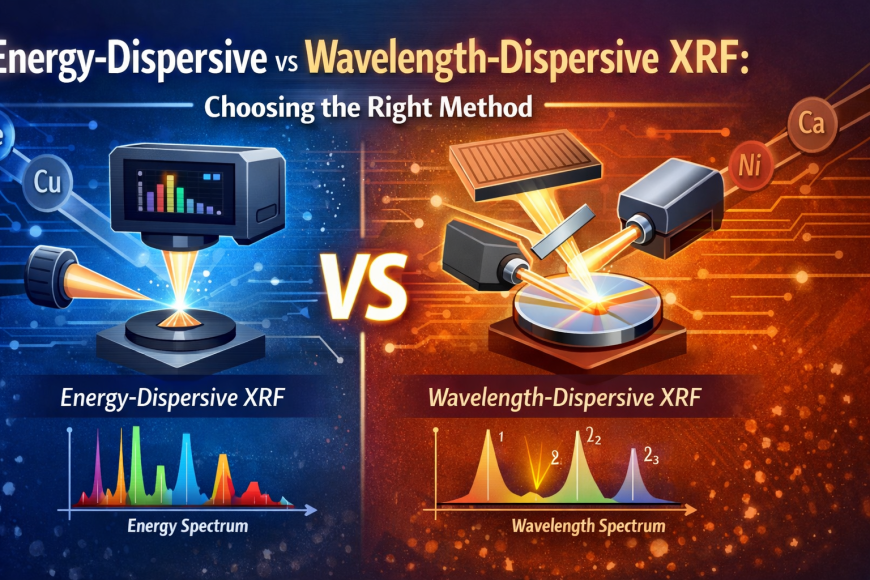
However, not all XRF systems are the same. The two primary technologies—Energy-Dispersive XRF (EDXRF) and Wavelength-Dispersive XRF (WDXRF)—offer distinct advantages and are suited for different applications.
1. Understanding the Principle of XRF
XRF works on a simple but powerful principle:
-
A primary X-ray beam strikes the sample.
-
Atoms in the sample become excited and eject inner-shell electrons.
-
Outer-shell electrons fill the vacancy.
-
The atom emits secondary (fluorescent) X-rays with characteristic energies.
-
These emitted X-rays are measured to identify and quantify elements.
The difference between EDXRF and WDXRF lies in how these emitted X-rays are separated and detected.
2. What is Energy-Dispersive XRF (EDXRF)?
Working Principle
In EDXRF systems:
-
The detector measures the energy of each emitted X-ray photon.
-
All energies are collected simultaneously.
-
The system produces a full energy spectrum in one measurement.
Modern EDXRF instruments typically use solid-state detectors such as Silicon Drift Detectors (SDD), which allow fast and reliable multi-element analysis.
Key Features of EDXRF
-
Simultaneous multi-element detection
-
Compact instrument design
-
Often available in benchtop and handheld formats
-
Minimal mechanical components
-
Lower operational complexity
Advantages of EDXRF
1. Faster Analysis
Because all element energies are detected at once, EDXRF offers rapid screening.
2. Cost-Effective
EDXRF systems are generally more affordable than WDXRF systems.
3. Portability
Handheld XRF analyzers are widely used for:
-
Scrap sorting
-
Field geology
-
Environmental inspections
4. Lower Maintenance
Fewer moving parts reduce mechanical wear and servicing needs.
Limitations of EDXRF
-
Moderate spectral resolution
-
Peak overlap issues in complex matrices
-
Slightly higher detection limits compared to WDXRF
-
Less suitable for ultra-trace analysis
Typical Applications of EDXRF
-
RoHS compliance testing
-
Scrap metal sorting
-
Soil contamination screening
-
Coating thickness analysis
-
Routine quality control
3. What is Wavelength-Dispersive XRF (WDXRF)?
Working Principle
In WDXRF systems:
-
Fluorescent X-rays are separated by diffraction crystals.
-
Each wavelength is measured individually.
-
A goniometer precisely positions crystals and detectors.
-
Only one element (or wavelength) is measured at a time.
This crystal-based separation provides significantly better peak resolution.
Key Features of WDXRF
-
Sequential elemental measurement
-
High spectral resolution
-
Better peak separation
-
Lower background noise
-
High precision and repeatability
Advantages of WDXRF
1. Superior Resolution
WDXRF can distinguish between elements with closely overlapping peaks.
2. Lower Detection Limits
Ideal for trace and ultra-trace analysis.
3. Higher Precision
More accurate quantitative results.
4. Better for Complex Samples
Performs exceptionally well in multi-element, complex matrices.
Limitations of WDXRF
-
Higher capital investment
-
Larger footprint
-
More mechanical components
-
Longer analysis time per element
-
Higher operational complexity
Typical Applications of WDXRF
-
Cement and clinker analysis
-
Mining and ore characterization
-
Metallurgical quality control
-
Petrochemical analysis
-
Research laboratories
4. Technical Comparison: EDXRF vs WDXRF
|
Parameter |
EDXRF |
WDXRF |
|
Detection Method |
Energy measurement |
Wavelength separation |
|
Measurement Mode |
Simultaneous |
Sequential |
|
Spectral Resolution |
Moderate |
High |
|
Detection Limits |
Good |
Excellent |
|
Precision |
Good |
Very High |
|
Speed |
Fast |
Moderate |
|
Cost |
Lower |
Higher |
|
Maintenance |
Low |
Moderate |
|
Portability |
Available |
Rare |
5. Analytical Performance Differences
Spectral Resolution
WDXRF provides significantly better peak separation, reducing interference from overlapping elements.
Example: Elements like titanium and vanadium may produce overlapping peaks in EDXRF, but WDXRF can separate them more clearly.
Detection Limits
-
EDXRF: Typically ppm level
-
WDXRF: Lower ppm or sub-ppm level
For industries requiring regulatory compliance with strict thresholds, WDXRF often becomes the preferred choice.
Matrix Effects
Matrix effects occur when the presence of certain elements affects the measurement of others.
WDXRF handles matrix correction more effectively due to its wavelength separation capability.
6. Cost Considerations
Initial Investment
-
EDXRF systems are more budget-friendly.
-
WDXRF systems require higher capital expenditure.
Operational Costs
WDXRF may involve:
-
Crystal replacement
-
Mechanical servicing
-
More technical calibration
EDXRF systems typically have lower long-term maintenance costs.
7. Which Method Should You Choose?
The correct choice depends on your laboratory’s needs.
Choose EDXRF If:
-
You require rapid screening.
-
Budget is limited.
-
Portability is essential.
-
Your analysis is routine and not ultra-trace.
-
You work in environmental monitoring or scrap sorting.
Choose WDXRF If:
-
You require maximum accuracy.
-
You analyze complex materials.
-
Trace-level detection is critical.
-
You work in cement, mining, or metallurgy.
-
Regulatory standards demand high precision.
8. Industry-Specific Recommendations
Mining & Geology
WDXRF for precise ore composition and grade control.
Cement Industry
WDXRF for clinker chemistry and raw mix control.
Environmental Testing
EDXRF for quick soil contamination screening.
Manufacturing
EDXRF for fast quality checks; WDXRF for final certification.
Research Laboratories
WDXRF for detailed material characterization.
9. Future Trends in XRF Technology
Advancements are narrowing the performance gap between EDXRF and WDXRF:
-
Improved detector technology
-
Enhanced software algorithms
-
AI-assisted spectral deconvolution
-
Hybrid systems
However, the fundamental difference in resolution and detection capability remains.
Final Conclusion
Both EDXRF and WDXRF are powerful implementations of X-ray fluorescence, but they serve different analytical priorities.
-
EDXRF excels in speed, cost-efficiency, and portability.
-
WDXRF excels in precision, resolution, and trace analysis.
There is no universal “best” system - only the one best suited for your analytical requirements.
Before investing, evaluate:
-
Required detection limits
-
Sample complexity
-
Throughput needs
-
Budget
-
Available lab space
-
Regulatory requirements
Making an informed choice ensures long-term efficiency, reliability, and return on investment for your laboratory.