Best Pilot Training Institute in Delhi: A Complete Guide for Aspiring Pilots
Discover how to choose the Best Pilot Training Institute in Delhi, from DGCA ground classes and CPL preparation to faculty, study support, and training guidance.
 70knotsaviation
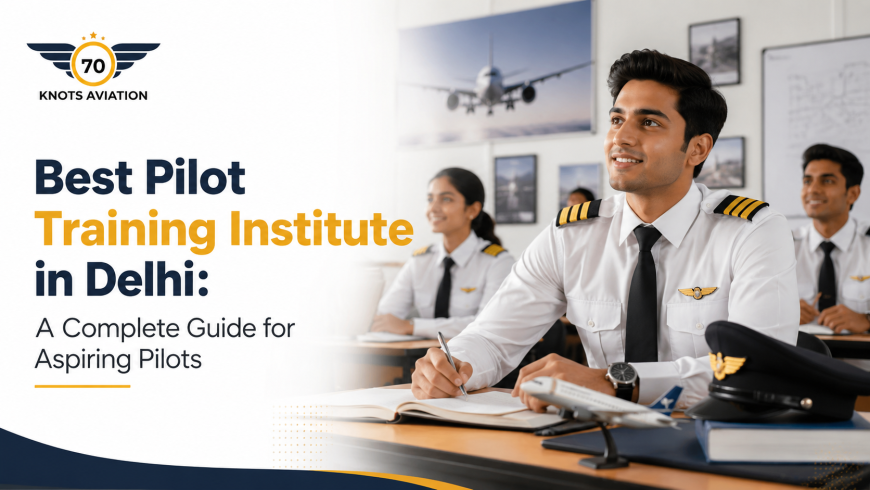
Choosing the Best Pilot Training Institute in Delhi is one of the most important decisions an aspiring pilot makes. Flight training involves significant time, effort, and financial investment, so students should look beyond advertisements and compare the actual quality of training, faculty, study support, infrastructure, and guidance available.
For a student beginning the journey toward a Commercial Pilot Licence (CPL), the process can initially seem complicated. There are DGCA examinations to prepare for, aviation subjects to understand, flight training requirements to complete, and several regulatory steps to follow. A good training institute can make this journey more structured and easier to understand.
Delhi is also a practical location for aviation students because it has access to a large aviation ecosystem, experienced professionals, and students from different parts of India. However, being located in Delhi does not automatically make an institute the right choice.
This guide explains what students should evaluate before selecting a pilot training institute, how DGCA ground classes fit into the CPL journey, what questions to ask before enrolling, and how 70Knots Aviation can support students through the academic side of pilot training.
What Does a Pilot Training Institute Actually Provide?
Pilot training is not limited to learning how to operate an aircraft. Before and during flight training, students need to develop a strong understanding of aviation theory, regulations, navigation, meteorology, aircraft systems, and communication procedures.
A pilot training institute generally focuses on the academic or ground-training side of this process. Students learn the theoretical concepts that support safe and effective flying and prepare for the relevant DGCA examinations.
Ground training is especially important because aviation subjects are interconnected. For example, a student studying air navigation needs to understand how weather conditions, aircraft performance, instruments, charts, and regulations can influence a flight.
A good instructor therefore does more than complete a syllabus. The instructor should explain why a particular concept matters and how it can appear in examinations as well as real-world aviation operations.
For students researching the Best Pilot Training Institute in Delhi, this distinction is important. The goal should not simply be to find a classroom that promises quick exam preparation. Students should look for an environment that develops a strong aviation foundation.
Why DGCA Ground Training Matters
DGCA ground training forms an important part of the pilot-training journey. Students preparing for commercial aviation need to understand the theoretical side of flying before they can confidently apply that knowledge in practical situations.
Ground classes can help students organise a large syllabus into manageable topics. Instead of studying several aviation subjects independently without knowing where to begin, students can follow a structured learning schedule.
The quality of teaching also matters. Aviation subjects contain technical terminology, calculations, regulations, and concepts that may be unfamiliar to beginners. An experienced instructor can simplify difficult topics without compromising technical accuracy.
Students researching Best DGCA Ground classes in Dwarka should therefore compare teaching methodology, faculty experience, study material, doubt-solving support, mock tests, and the institute's approach to examination preparation.
Choosing a ground-training location is only one part of the decision. Students should also consider how consistently they can attend classes, interact with instructors, revise lessons, and receive academic support throughout their preparation.
For students considering different areas of Delhi, accessibility can make a difference to their daily routine. However, convenience should always be balanced with teaching quality, course structure, and student support.
The same principle becomes important when students compare training options in different parts of the city. A suitable institute should provide a learning environment where students can remain consistent with their preparation rather than simply choosing a centre because it is nearby.
How to Choose the Best Pilot Training Institute in Delhi
Faculty and Teaching Experience
The quality of instruction can have a major impact on how quickly a student understands aviation subjects. Teachers should be able to explain technical concepts clearly and answer questions with practical context.
A classroom where students are encouraged to ask questions can be more valuable than one focused entirely on completing chapters.
Study Material and Test Preparation
Good study material should help students revise concepts systematically. Regular tests can also identify weak areas before the actual examination.
Students should ask whether the institute provides revision sessions, mock examinations, question-solving practice, and feedback on performance.
Learning Environment
Pilot training requires discipline. Students often have to balance multiple subjects and maintain a consistent study schedule.
A professional classroom environment can help students develop the routine needed for aviation education. The best learning environment is not necessarily the largest one; it is the one where students can concentrate and receive appropriate academic support.
Transparency
Students and parents should be cautious about institutes making unrealistic promises about licences, jobs, salaries, or guaranteed aviation careers.
A trustworthy institute should explain the process clearly, including what it provides, what the student must arrange independently, and what stages are involved in becoming a professional pilot.
Subjects Students Need to Prepare For
The theoretical portion of pilot training covers several important aviation areas. The exact requirements depend on the applicable DGCA licensing and examination framework, but students commonly encounter subjects such as aviation meteorology, air regulations, air navigation, and aircraft-related technical knowledge.
Aviation meteorology teaches students how weather affects aviation operations. Understanding clouds, visibility, wind, pressure systems, thunderstorms, and other weather phenomena is essential for making informed decisions during flight planning.
Air regulations introduce students to the rules and procedures governing aviation operations. These concepts are particularly important because pilots operate within a highly regulated environment.
Air navigation develops the ability to understand charts, routes, headings, distances, time, and other navigational concepts. Students who initially find navigation difficult often benefit from regular numerical practice rather than relying solely on memorisation.
Communication is another important component. Aviation communication requires accuracy and standard terminology. Training related to radio communication helps students understand how pilots communicate with air traffic services and other aviation personnel.
This broad academic foundation is one reason students should carefully evaluate ground-school quality before committing to a training pathway.
Classroom Training vs Self-Study
Self-study can be useful, especially for revision, but it can become challenging when students encounter unfamiliar technical concepts.
Consider a student preparing for a DGCA examination who understands the basic formula used in a navigation problem but repeatedly gets the wrong answer. Without guidance, the student may spend hours practising without identifying the actual mistake.
An instructor can examine the method, identify the problem, and explain the concept from another angle. This can save time and prevent the student from developing incorrect habits.
Classroom training also provides structure. Students have fixed schedules, instructors to approach, and peers who may be facing similar challenges.
That does not mean students should depend entirely on classroom teaching. Successful aviation students usually combine classroom instruction with regular independent study, revision, practice questions, and self-assessment.
Understanding CPL Training and Flight School Selection
A Commercial Pilot Licence is not earned through classroom education alone. Students pursuing a CPL also need to complete the required practical flight training and other applicable regulatory requirements.
This means students should understand the difference between ground training and flight training before choosing an institute.
A ground-training institute may prepare students academically, while flight training is completed through an approved flight training organisation according to applicable requirements.
Students should therefore avoid assuming that enrolling in a ground school automatically completes the entire CPL process.
For example, a student may complete strong theoretical preparation in Delhi and then choose a suitable flight training organisation based on factors such as aircraft availability, weather, operational environment, instructor availability, training schedule, and overall cost.
Students exploring options outside Delhi may also come across programmes such as the Best DGCA CPL Classes in Hyderabad. Comparing locations can be useful, but the same evaluation criteria should be applied everywhere: faculty, curriculum, examination support, transparency, and training quality.
Regardless of the city, students should carefully review the course structure and understand which parts of their pilot-training journey are covered by the institute and which require separate arrangements.
Why Location and Accessibility Matter
Aviation students often underestimate the importance of a convenient study location. Ground training requires regular attendance and consistent revision. Long daily travel can eventually affect concentration and study time.
For Delhi-based students, an institute located within reasonable travelling distance can make it easier to attend classes regularly and participate in doubt-solving or revision sessions.
However, location should remain one part of the decision rather than the entire decision.
A student should not choose an institute simply because it is close to home if the teaching quality, academic support, or learning environment does not meet expectations.
The ideal balance is a training centre that is accessible while also providing the academic standards the student needs.
Students researching options around Ramphal Chowk should also look beyond proximity and examine the quality of classroom instruction, revision support, faculty interaction, and preparation methods. These factors can have a greater impact on learning outcomes than location alone.
Those specifically comparing Best DGCA Ground classes in Ramphal Chowk should therefore evaluate the complete learning experience before making a final decision.
Common Mistakes Students Make When Choosing an Institute
Many students make their decision based on a single advertisement or recommendation. While recommendations can be helpful, aviation education deserves deeper research.
- Choosing an institute only because it advertises itself as the “best” without comparing its actual facilities and teaching approach.
- Selecting a course based only on price without understanding what is included.
- Assuming ground classes and flight training are automatically part of the same programme.
- Ignoring faculty quality and focusing only on location or classroom appearance.
- Believing unrealistic promises about guaranteed jobs, licences, or career outcomes.
Students should also speak with current or former students where possible. Their experience can provide useful insight into classroom discipline, faculty accessibility, study material, examination preparation, and day-to-day support.
How 70Knots Aviation Can Support Aspiring Pilots
70Knots Aviation focuses on aviation education and ground-class preparation for students working toward professional pilot careers.
For a beginner, one of the biggest advantages of structured ground training is having a clear academic pathway. Instead of treating every aviation subject as an isolated topic, students can understand how different areas contribute to their overall pilot-training journey.
The learning process should encourage students to understand concepts rather than simply memorise answers. This approach becomes particularly valuable when students encounter numerical problems, regulations, navigation exercises, or technical topics that require proper understanding.
Students considering the Best Pilot Training Institute in Delhi should also evaluate how an institute communicates with learners. Clear explanations about course structure, examination preparation, expectations, and the overall pilot-training process help students make better decisions.
At 70Knots Aviation, the emphasis can be placed on building the academic foundation students need before moving further into their professional aviation journey. The objective should always be responsible preparation rather than unrealistic promises.
What Should Students Ask Before Enrolling?
Before paying course fees, students should have a direct conversation with the institute. A short discussion can reveal a great deal about how transparent and student-focused the organisation is.
Useful questions include:
- Who will teach the subjects, and what is their aviation teaching experience?
- What subjects are covered in the course?
- How are doubts and difficult topics handled?
- Does the course include mock tests or revision sessions?
- What study material is provided?
- What does the course fee include?
- Which parts of the CPL journey must be completed separately?
- How does the institute help students prepare for DGCA examinations?
Clear answers to these questions allow students to compare institutes based on value rather than marketing language.
Comparing Pilot Training Options Beyond Delhi
Delhi is not the only location where aspiring pilots can receive aviation education. Students may compare different cities based on their academic requirements, personal circumstances, and future training plans.
For example, someone researching the Best Pilot Training Institute in Chennai may have different considerations related to location, accommodation, travel, or access to flight-training opportunities.
Students should remember that the right choice depends on their individual circumstances. A student relocating to another city may need to consider accommodation, travel expenses, class schedules, and the availability of academic support alongside the quality of teaching.
Similarly, students searching for the Best CPL DGCA ground classes in Kolkata should evaluate the same fundamentals that apply in Delhi: faculty expertise, structured teaching, examination preparation, learning support, and transparency.
The important lesson is that a city name alone does not determine training quality. Students should compare the actual educational experience offered by each institute.
Frequently Asked Questions
1. How do I choose the best pilot training institute in Delhi?
Compare faculty experience, course structure, DGCA examination preparation, study material, mock tests, student support, transparency, and location. Do not base the decision solely on advertisements or fees.
2. Are DGCA ground classes necessary for becoming a pilot?
Ground training is an important part of preparing for the theoretical and examination requirements associated with pilot licensing. Structured classes can help students understand technical subjects and prepare systematically.
3. Does ground training include flight training?
Not necessarily. Ground training and practical flight training are separate components of pilot education. Students should confirm exactly what is included in an institute's programme before enrolling.
4. What subjects are covered in DGCA ground training?
Depending on the applicable licensing requirements, students may study areas such as air navigation, aviation meteorology, air regulations, technical subjects, and aviation communication.
5. Is Delhi a good location for pilot ground training?
Delhi can be a practical location for ground education because of its established aviation ecosystem and accessibility for students from different regions. However, the quality of the individual institute remains more important than the city itself.
6. Should I choose a pilot training institute based on low fees?
Cost is an important consideration, but it should not be the only factor. Students should understand what is included in the fee and compare teaching quality, support, study resources, and course structure.
7. Can I complete my ground classes in Delhi and flight training elsewhere?
In many pilot-training pathways, students may complete their academic preparation in one location and practical flight training through an appropriate flight training organisation elsewhere, subject to applicable requirements and arrangements.
8. How long does it take to become a commercial pilot?
The timeline varies depending on examination progress, medical requirements, flight-training availability, weather, individual performance, regulatory requirements, and other factors. Students should avoid institutes that promise an identical completion time for everyone.
Conclusion
Choosing the Best Pilot Training Institute in Delhi should be treated as an educational decision rather than a simple purchase. Students need an institute that provides clear instruction, structured preparation, experienced guidance, and a realistic understanding of the professional pilot-training pathway.
A strong foundation in aviation theory can make later stages of training easier to manage. At the same time, students should remember that becoming a professional pilot involves several stages, including examinations, medical requirements, practical flight training, and compliance with applicable aviation regulations.
Whether a student is comparing ground schools in Delhi or considering options in another city, the best approach is to research carefully, ask questions, compare what each institute actually provides, and choose based on genuine educational value.
For students beginning their aviation journey, 70Knots Aviation can be considered as one of the options for structured aviation ground training and academic preparation in Delhi.